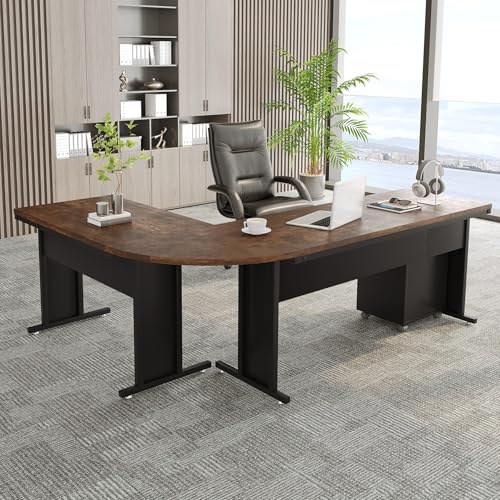
Industrial L Shaped Desk with Drawers: Complete Buyer's Guide
Everything you need to know before choosing a corner workspace that combines rugged style, generous surface area, and practical drawer storage for a productive home office.
EXPLORE RECOMMENDED MODELSWhy this guide matters: An industrial L shaped desk with drawers solves two problems at once — it gives you a large, wrap-around work surface and keeps everyday items within arm's reach. This guide breaks down frame construction, surface materials, drawer configurations, ergonomics, and setup strategies so you can decide with confidence.
What Defines an Industrial L Shaped Desk with Drawers?
The industrial aesthetic borrows from factory and warehouse design: exposed metal frames, bolt or rivet detailing, matte finishes, and warm wood tones. When applied to an L shaped desk, this style produces a substantial corner workstation that looks purposeful rather than delicate. The drawer component adds functional storage for office supplies, documents, and accessories that would otherwise clutter the desktop.
A true industrial L shaped desk with drawers typically includes three structural elements: a heavy-duty steel or metal frame, a wood or engineered wood top with a visible grain or distressed finish, and at least one integrated drawer bank or pedestal. Some models add open shelving, a hutch, or a monitor riser to extend the factory-inspired look.
Frame and Material Construction
The frame is the backbone of any L shaped desk. Industrial models usually rely on steel tubing, often powder-coated for rust resistance. Look for reinforced corner brackets where the two wings meet, because that joint carries the most stress. A well-built frame should feel rigid with minimal side-to-side wobble, even when you lean on the return.
Surface Materials to Consider
- Solid wood tops: Durable and repairable, with natural grain that suits the industrial palette. Heavier and generally positioned in the premium tier.
- Engineered wood with wood veneer: A balanced tier option that delivers the look of real wood with improved dimensional stability.
- Laminate or melamine surfaces: Entry-level to mid-range choices that resist scratches and spills, ideal for busy households.
- Metal tops or metal accents: Occasionally used on utility-style industrial desks, offering a distinctly workshop feel.
If you want to dig deeper into frame options before committing, the desk frame guide explains how steel gauge, leg shape, and bracing affect stability. For a broader look at the style itself, see the industrial desk overview.
Drawer Configurations and Storage Layouts
Drawer placement is one of the most practical decisions in an L shaped desk. Because the desk has two wings, the drawer bank can sit on the left return, the right return, or in the corner. Many models are reversible, letting you flip the drawer pedestal during assembly.
Common Drawer Layouts
| Layout | Best For | Considerations |
|---|---|---|
| Single file drawer + two utility drawers | General home office use | Balanced storage for documents and small supplies |
| Three-drawer pedestal on one wing | Users who need filing space | Confirm the pedestal does not block legroom |
| Corner drawer unit with open shelf above | Compact rooms | Maximizes the deepest part of the L shape |
| Drawers plus hutch or monitor shelf | Multi-monitor setups | Adds vertical storage but increases visual weight |
Drawer glide quality matters more than drawer count. Ball-bearing slides with a smooth full extension are a hallmark of mid-tier and high-end tier models, while entry-level desks may use simpler roller glides. Check whether the drawers have stops to prevent accidental pull-out.
Ergonomics and Desk Dimensions
L shaped desks are often chosen for the extra surface area, but ergonomics still depend on height and depth. Standard desk height sits around 29 to 30 inches, which suits many adults but not everyone. If you are shorter or taller, consider an adjustable-height model or add a keyboard tray to fine-tune your working posture.
The return wing should be deep enough to host a second monitor or a laptop without crowding your primary workspace. A depth of at least 20 inches on the return is a practical baseline. For posture guidance and monitor distance, the monitor placement guide is a useful reference.
Strengths of Industrial L Shaped Desks
- Large wrap-around surface for multi-tasking
- Integrated drawers reduce desktop clutter
- Heavy-duty frame construction for stability
- Distinctive factory-inspired aesthetic
- Often easier cable routing via open frames
Trade-offs to Weigh
- Requires a larger footprint than straight desks
- Corner placement limits room layout options
- Heavier to move and assemble
- Drawer pedestal may reduce legroom on one side
- Industrial finishes can show dust on dark surfaces
Matching the Desk to Your Workspace
Before choosing a specific model, map the corner where the desk will live. Measure the wall lengths on both sides and subtract clearance for doors, windows, and radiators. An L shaped desk placed in a corner should still leave enough room to pull out the chair and open drawers fully.
If your room is tight, a reversible design helps you orient the return toward the shorter wall. For very compact spaces, consider pairing the corner desk with a small-space desk strategy or a desk side table for extra surface without expanding the footprint.
Lighting and Ambiance
Industrial desks pair well with warm task lighting. A green glass shade lamp or an adjustable arm lamp reinforces the vintage factory look while providing focused light for reading and writing. Layered lighting — task lamp plus ambient room light — reduces eye strain during long work sessions.
Cable Management and Organization
Open industrial frames make cable management easier, but they also expose messy wiring. Look for desks with pre-drilled grommets, under-desk cable trays, or a back rail where you can mount a power strip. Group device cables with a sleeve or velcro ties, and route them along the frame rather than letting them hang loose.
Drawers should hold frequently used items, not everything. Keep the desktop clear by storing chargers, notebooks, and small tools in the drawer bank, and reserve one drawer for documents. For a deeper dive into routing techniques, the cable management guide covers trays, raceways, and wireless setups.
Quality Tiers: How to Compare Models
Industrial L shaped desks with drawers span several quality tiers. Use the following descriptors to compare models without relying on numerical figures:
- Entry-level: Laminate surfaces, thinner steel frames, basic roller glides. Suitable for light use and occasional work.
- Mid-range: Reinforced steel frames, engineered wood with veneer, ball-bearing drawer slides. A solid choice for daily home office use.
- Premium: Solid wood tops, heavy-gauge steel, full-extension soft-close drawers, and thoughtful cable routing. Built for long-term daily use.
- Professional-grade / commercial-grade: Designed for heavy workloads, often with reinforced corner joints, higher load ratings, and modular storage. Best for intensive multi-monitor or creative setups.
For a broader comparison of office-oriented models, see the adjustable desk for office guide. If you are weighing a height-adjustable variant, the L shaped desk that moves up and down article explains the trade-offs.
Assembly, Placement, and Maintenance
Most industrial L shaped desks ship flat-packed and require two people for assembly, especially when the corner joint is heavy. Assemble the frame upside down on a soft surface, attach the legs and cross-braces, then flip the frame and mount the tabletop. Leave the drawer pedestal for last so you can confirm the orientation.
For maintenance, dust the frame with a dry cloth and wipe wood surfaces with a slightly damp cloth. Avoid harsh cleaners on powder-coated steel, as they can dull the finish. If the desk sits near a window, rotate decorative items periodically to prevent uneven fading.
Frequently Asked Questions
What makes an L shaped desk with drawers industrial in style?
An industrial style usually combines a heavy-duty metal frame, often in matte black or gunmetal, with wood or wood-look surfaces. Visible hardware, rivet details, open shelving, and raw textures complete the look, while integrated drawers add practical storage.
Which side should the drawers be on for an L shaped desk?
Choose a reversible or modular design so you can place the drawer pedestal on whichever return best fits your room layout. Consider which hand you use for writing, where you enter the desk, and whether the drawer bank will block a window or doorway.
Are industrial L shaped desks with drawers sturdy enough for dual monitors?
Most mid-range and high-end tier models use high-grade steel frames and reinforced tabletop panels that comfortably support dual monitors, monitor arms, and a full desktop setup. Always check the listed load capacity and use a monitor arm rated for your screen size.
How do I organize cables on an industrial L shaped desk?
Look for models with built-in cable grommets, under-desk cable trays, and open back panels. Pair the desk with a cable sleeve or raceway and route power strips along the frame to keep the industrial look clean.
Can an industrial L shaped desk work in a small room?
Yes, provided you measure carefully and choose a reversible model with a narrower return. Corner placement maximizes usable floor space, and a desk with drawers eliminates the need for a separate filing cabinet, which can save room overall.