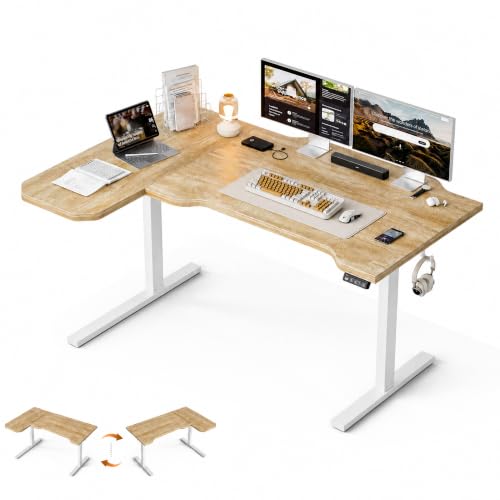
L Shaped Desk With One Side Shorter: Smart Space, Better Workflow
An L shaped desk with one side shorter gives you the wrap-around workspace of a corner desk without swallowing the whole room. This guide explains when the asymmetric short-return layout works best, how to plan the footprint, which storage pairings make sense, and what to check before you commit.
What "One Side Shorter" Means on an L Shaped Desk
A standard L shaped desk has two runs of similar length that meet at a 90-degree corner, forming a balanced "L". When one side is shorter, the desk becomes asymmetric: one long main run carries the monitor, keyboard, and primary work zone, while a shorter return tucks against a wall or floats beside it to add secondary surface area.
This short return typically measures anywhere from a narrow shelf-width ledge to roughly two-thirds the length of the main run. The result is a desk that still wraps around the user — giving that familiar corner-desk reach — but leaves noticeably more open floor space on the short side.
Two Ways the Short Side Appears
- Short return depth: the return run has a shallower front-to-back depth, so it hugs the wall without jutting into the room.
- Short return length: the return run is physically shorter end-to-end, leaving a clear path beside the desk.
Many models combine both, producing a compact wing that works as a landing zone for a laptop, a reference monitor, or a stack of documents rather than a full second workstation.
Why Choose an L Shaped Desk With an Asymmetric Return
The short-return format solves a specific tension: you want the productivity benefits of a corner desk, but a symmetric L is simply too large for the room. Here is what the asymmetric layout delivers.
1. Corner Reach Without the Corner Bulk
You still get the ergonomic advantage of a wrap-around work zone — the short return sits within arm's reach, so you can swivel between the main run and the side surface without rolling across the room. But because one arm is trimmed, the desk doesn't dominate the floor plan.
2. A Natural Zoning Surface
The shorter side is an excellent secondary zone: a laptop dock, a printer shelf, a writing nook, or a place to set a mug and notebook away from the keyboard. It separates "active typing" space from "reference and overflow" space.
3. Better Door and Window Clearance
If your office has a door on one wall and a window on another, a full symmetric L often forces awkward furniture shuffling. A short return lets you keep the long run against the solid wall while the trimmed side steps back from the opening.
4. More Visual Breathing Room
Asymmetric furniture reads lighter in a room. The open floor beside the short return makes even a modest home office feel less crowded, which matters in bedrooms, studio apartments, and shared living spaces.
5. Easier Cable and Power Routing
With one compact arm, cable runs from the main workstation to a wall outlet are shorter and simpler. Fewer long horizontal spans mean fewer opportunities for tangled loops under the desk.
If you are comparing this against a full-size corner layout, our overview of L shaped desks for home office use covers the broader family of options.
Who This Layout Suits Best
The short-return L desk is not a universal answer — it shines in specific situations and is a poor match in others. Here is the honest breakdown.
Strong Fits
- Compact home offices: rooms under roughly 100 square feet where a symmetric L would eliminate walking space.
- Bedroom workstations: the trimmed return keeps the desk from crowding the bed or wardrobe.
- Studio apartments: the desk doubles as a room divider while the short side preserves a path to the kitchen or entry.
- Single-monitor plus laptop users: the main run holds the display; the short return holds the laptop or a tablet.
- Creatives who need a side surface: sketching, cutting, or laying out reference material beside the main keyboard zone.
- Hybrid workers: a lighter footprint makes it easier to reconfigure the room when the desk is not in use.
Weaker Fits
- Triple-monitor battlestations: the short return usually cannot support a third full-size display comfortably.
- Two-person shared desks: the asymmetric surface does not split evenly between users.
- Heavy filing needs: a short return leaves less room for full-depth file cabinets underneath.
- Dedicated large-format drafting: the reduced return depth limits wide-format paper work.
Space Planning and Footprint
Before choosing a model, measure the room properly. The asymmetric L is a space-saving format, but only if the short return lands on the correct side.
Measure These Four Dimensions
- Main run length: the long side that holds your monitor and keyboard. Aim for at least 47 inches (about 120 cm) for a single monitor plus working room.
- Return length: the short side. Even 24 to 36 inches of usable surface can serve as a laptop or reference zone.
- Surface depth: the main run usually needs 24 to 30 inches; the short return can be shallower, often 16 to 20 inches.
- Clear floor path: leave at least 30 inches of walkway beside the short return so the desk does not become a trip hazard.
Left vs Right Return
The short side should sit on the wall with the fewest obstructions. If the door opens on your right, a short left return keeps the entry clear. If you are left-handed, a short right return may feel more natural for a notepad or mouse hand. Reversible models let you flip the configuration later — useful if you plan to rearrange the room.
Wall and Window Considerations
- Place the long run against a solid wall for cable routing and visual anchoring.
- Keep the short return away from radiators, heating vents, and direct window glare if a monitor sits there.
- Leave a few inches of clearance behind the return for ventilation and cable drops.
If you are weighing a short return against a compact straight desk, a compact L shaped desk with drawers for small space shows how storage changes the footprint math.
Ergonomics of the Short Return
The asymmetric layout changes how you sit, so ergonomic planning matters more than on a symmetric desk. The goal is to keep the main work zone centered and use the short return as a reach-zone rather than a second typing station.
Seating Position
Sit at the inside corner where the two runs meet, with your monitor centered on the long run and roughly an arm's length away. Your forearms should rest level on the main surface. The short return should sit just outside your neutral typing position — close enough to swivel toward, far enough not to encourage twisting while typing.
Monitor Placement
- Primary display on the long run, centered on your seated position.
- Secondary display or laptop on the short return, angled inward toward you.
- Avoid placing the main monitor on the short return if it forces you to twist your torso for hours.
Desk Height
For most seated users, a fixed surface around 28 to 30 inches works. If the short return shares the same surface height as the main run, transitions between zones feel seamless. Height-adjustable frames remove the guesswork entirely and let you stand for part of the day — see our notes on L shaped desks that move up and down if adjustability is a priority.
Lighting and Glare
The short return often faces a different direction than the main run, so light falls unevenly. A task lamp with an adjustable arm helps balance the two zones, and a matte desk surface reduces glare on the secondary side.
Storage Pairings That Fit the Short Return
Because the short return has less floor area beneath it, storage choices need to be deliberate. Here is how the most common pairings behave on an asymmetric L desk.
| Storage Type | Best For | Notes on a Short Return |
|---|---|---|
| Mobile file cabinet | Flexible filing | Rolls under the long run and tucks beside the short return when needed. |
| Fixed pedestal drawers | Dedicated storage | Plan the pedestal on the long run; short returns often lack the depth. |
| Under-desk shelf unit | Book and binder storage | Works well under the main run; keep the short side clear for legroom. |
| Hutch or riser | Vertical storage | Best on the long run; a narrow hutch can fit the short return in some models. |
| Wall-mounted shelving | Zero footprint | Ideal above the short return where floor space is tight. |
If you want dedicated drawer capacity, a model like an L shaped desk with drawers is worth comparing against the short-return format. For heavier filing needs, an L shaped desk with file cabinet adds deep storage but generally needs the long run for the cabinet.
Vertical storage is the safest bet on a short return. A hutch-topped L shaped desk or a wall-mounted shelf keeps the compact arm functional without stealing floor space.
Materials and Frame Choices
Material choice affects durability, cable management, and how heavy the desk feels in a small room. Here is a practical breakdown for an asymmetric L configuration.
Surfaces
- Laminate: the most common surface for short-return L desks because it keeps the structure light and resists everyday wear. Explore laminate desk options if you want a low-maintenance finish.
- Engineered wood with veneer: a step up in appearance while remaining dimensionally stable — see L shaped wood desks for the wood-look family.
- Solid wood: the most durable option for the long run, though heavier. A wood L shaped desk with drawers pairs well with a short return if you keep the drawer bank on the main run.
Frames
Steel frames dominate the category. Check that the short return is supported by its own leg or bracket rather than cantilevering off the main run — a cantilevered short side will flex under a laptop or reference monitor. Reinforced corner brackets and a crossbar improve rigidity on asymmetric layouts.
Weight and Stability
Asymmetric desks can tip more easily if the weight is concentrated on the short side. Keep the heaviest items (monitor arm, printer, book stack) over the long run and near the corner joint. If you plan to mount a monitor arm on the short return, verify the surface thickness and reinforcement.
Fixed vs Adjustable vs Reversible Short-Return Desks
Within the asymmetric L category, three configurations dominate. Each serves a different buyer profile.
| Configuration | Tier | Best For |
|---|---|---|
| Fixed-height asymmetric L | Entry-level to mid-range | Seated-only users with a stable room layout. |
| Height-adjustable asymmetric L | Premium | Hybrid workers who alternate sitting and standing; long-term investment. |
| Reversible short return | Mid-range to high-end tier | Renters or anyone who may rearrange the room; adds flexibility. |
Height-adjustable frames add mechanical complexity, so check the lift capacity and confirm the short return is included in the stability spec. Reversible models are the most forgiving if you are unsure which side the short return should land on — see our guide to reversible L shaped desks for how the flip mechanism works in practice.
If sit-stand is a core requirement, our overview of L shaped sit-stand desks with drawers shows how storage and adjustability coexist.
Common Mistakes to Avoid
- Choosing the short side by habit rather than by room: the return should match the wall and door layout, not just your dominant hand.
- Underestimating the return depth: a short return that is too shallow cannot hold a laptop and a notepad comfortably.
- Overloading the short side: keep heavy items over the main run and near the corner joint.
- Ignoring cable routing: the compact arm often has fewer grommets; plan a tray or raceway before assembly.
- Buying a hutch that blocks the view: on a short return, a tall hutch can dominate the room visually. Measure sightlines.
- Forgetting legroom: a short return with a fixed drawer bank leaves little knee space — check the underside clearance.
Pre-Purchase Checklist
Run through these checks before you commit to a specific model.
- Confirm the main run length supports your monitor setup and working area.
- Verify the short return depth can hold the items you plan to place there.
- Measure the walkway beside the short return — aim for 30 inches or more.
- Check which side the return sits on (left or right) against your room layout.
- Confirm the frame supports the short return with its own leg or bracket.
- Review cable management provisions: grommets, under-desk trays, or raceways.
- Decide whether a fixed, adjustable, or reversible configuration fits your long-term plans.
- Read stability specifications and weight capacity, especially if you plan a monitor arm.
For related storage-focused configurations, browse our L shaped desk with storage guide, or compare the broader category in L shaped desks for home office setups.
Frequently Asked Questions
Is an L shaped desk with one side shorter good for small rooms?
Yes. The asymmetric return keeps the wrap-around benefit of an L shape while freeing floor area on the short side, making it a strong fit for compact home offices, bedrooms, and studio apartments.
Can a short-return L desk be used for dual monitors?
Usually yes. Place the primary display on the long main run and angle the secondary monitor slightly inward toward the user. The shorter return is often better suited to a laptop, tablet, or reference display.
Which return side should I choose, left or right?
Match the return to your room layout and handedness. If the desk sits along a wall with a door on the right, a short left return keeps the entry clear. Reversible models let you change this later.
What desk height should a short-return L desk be?
A fixed desk surface around 28 to 30 inches suits most seated users, while a height-adjustable frame gives the most flexibility. Confirm the short return shares the same surface height as the main run.
Can I add a hutch or drawers to the short side?
A narrow hutch or wall-mounted shelf works well on the short return. Fixed drawer pedestals are usually better placed under the long run, since the short side often lacks the depth for full-size drawers.
Ready to Compare Short-Return L Desks?
Browse curated options that match the asymmetric layout, then check availability and configuration details before you decide.
Explore Desk Options