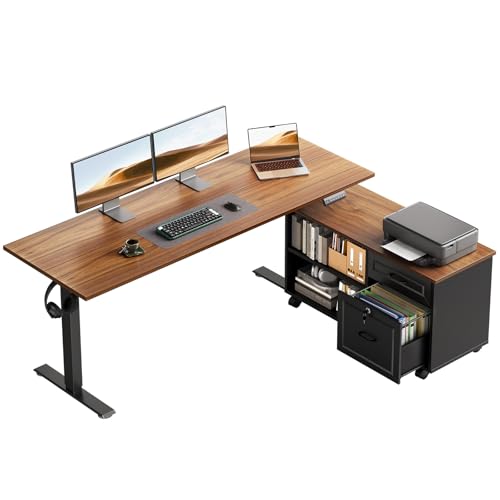
L-Shaped Desk with File Cabinet: The Complete Workspace Guide
Everything you need to know before choosing an L-shaped desk with an integrated file cabinet — storage capacity, configuration options, build quality, and how to match one to your home office workflow.
Explore Buying FactorsAn L-shaped desk with a file cabinet is one of the most practical workspace configurations for a home office. The corner layout maximizes usable surface area, while the built-in file cabinet keeps documents, folders, and office supplies within arm's reach — without needing a separate storage unit.
If you are in the research stage and already know you want this desk category, the decision usually comes down to four factors: cabinet capacity, return orientation, surface material, and build durability. This guide walks through each one so you can compare models with confidence.
Quick orientation: An L-shaped desk with a file cabinet combines two work zones — a primary surface and a return that houses the cabinet. The return can typically be installed on the left or right, which matters for how the desk fits into your room and where your dominant hand reaches for files.
Why Choose an L-Shaped Desk with a File Cabinet?
The combination solves a common home office problem: you need more surface area and organized document storage, but floor space is limited. Placing the file cabinet under the return of an L-shaped desk consolidates both needs into a single footprint.
- Dual work zones: Use one side for your monitor and keyboard, the other for paperwork, a printer, or a laptop station.
- Integrated storage: The file cabinet holds letter- and legal-size folders, keeping your desk surface clear.
- Corner efficiency: L-shaped footprints use corner space that a straight desk leaves empty.
- Cable and accessory routing: The return side often provides room for cable management and a power strip.
File Cabinet Types Found on L-Shaped Desks
Not all file cabinets are built the same. Understanding the differences helps you match the desk to your document volume and security needs.
| Cabinet Type | Best For | Key Consideration |
|---|---|---|
| Freestanding file cabinet | Flexible layouts and small spaces | Can be repositioned or removed; may not match desk finish |
| Integrated under-return cabinet | Permanent home office setups | Fixed placement; usually matches desk material |
| Locking file cabinet | Confidential documents and shared spaces | Verify key mechanism and lock quality |
| Mobile pedestal cabinet | Multi-use rooms and hybrid work | Casters should be lockable for stability |
| Two-drawer file cabinet | High document volume | Check drawer glides and weight rating |
If you prefer a cabinet that matches the desk exactly, look for models where the cabinet is built into the return. If you want the option to move storage later, a freestanding or mobile pedestal is more flexible. For document security, a locking file cabinet configuration is worth considering.
Key Buying Factors to Compare
When comparing models, use these criteria rather than focusing on any single specification in isolation.
1. Cabinet Capacity and Drawer Glides
Entry-level cabinets often handle letter-size folders only. Mid-range and high-end tier models typically support both letter and legal sizes with smoother ball-bearing glides. If you store heavy binders, prioritize drawer glides rated for higher loads.
2. Return Orientation (Left or Right)
Most L-shaped desks are reversible, meaning the return can be installed on either side. Confirm this in the specification — some models are fixed. A reversible design lets you place the cabinet where it is easiest to reach and where it does not block a window or doorway.
3. Surface Material and Finish
Engineered wood with a laminate finish is the most common surface in this category — durable and easy to clean. Solid wood and heavy-duty steel options sit at the high-end tier. Whichever you choose, verify the surface is scratch-resistant if you use a monitor arm or frequently move equipment.
4. Build Durability and Stability
A reinforced frame and heavy-duty legs reduce wobble, which matters more on an L-shaped desk because the return adds leverage. Look for descriptions that mention a solid build, reinforced brackets, or commercial-grade construction if the desk will hold multiple monitors or a printer.
5. Cable Management and Power Access
Models with grommets or a built-in power outlet simplify routing cables from the return side. This is especially useful if your file cabinet side also hosts a printer or charging station.
Practical tip: Measure both wall lengths of your corner before comparing desks. An L-shaped desk with a file cabinet needs clearance for drawer pull-out — typically at least 20 inches in front of the cabinet face.
Popular Configurations and Variations
The core concept stays the same, but the details vary widely. Here are the most common variations buyers compare:
- With hutch: Adds vertical shelving above the desk. Useful for books and decor, but reduces wall clearance — see L-shaped desk with file cabinet and hutch.
- With drawers: Combines a file cabinet with general-purpose drawers for supplies — see L-shaped desk with drawers.
- With keyboard tray: Frees surface space and improves ergonomics — see L-shaped desk with keyboard tray.
- Executive style: Larger surface and a more formal finish — see L-shaped executive desk.
- Home office focused: Balanced surface and storage for remote work — see L-shaped desks for home office.
- Office-grade storage: Filing-focused return for higher document volume — see L-shaped office desk with filing cabinet.
For buyers who need even more storage flexibility, models with multiple drawers and shelves are worth exploring. The L-shaped desk with lots of storage category covers configurations with a file cabinet plus additional compartments. If the cabinet must be detachable, look at the file drawer variant, which often uses a modular pedestal.
Materials and Finish Considerations
Because the file cabinet adds weight and mechanical parts, material choice affects long-term performance more than on a simple straight desk.
- Laminate over engineered wood: The most common choice. Resists scratches and moisture; a good value for its tier.
- Solid wood: A long-term investment with a premium feel. Heavier, so verify leg reinforcement.
- Metal frame with wood top: A balanced tier choice that combines stability with a warm surface.
- Commercial-grade laminate: Found in professional-grade models; designed for high-use environments.
If you want a warmer aesthetic, a wood L-shaped desk pairs naturally with a matching cabinet. For a cleaner, modern look, a white L-shaped desk with hutch may suit lighter rooms.
Setup and Ergonomics Advice
Once the desk is assembled, placement determines how comfortable it is day to day.
- Place the return against the shorter wall so the main surface faces the room and natural light.
- Put the file cabinet on your non-dominant side if you frequently open drawers while working.
- Keep the monitor on the main surface at roughly arm's length, with the return reserved for paperwork and the cabinet.
- Route cables through grommets before loading the cabinet — it is much harder to reorganize afterward.
- Leave clearance behind the cabinet for drawer travel and ventilation.
For buyers who also want to alternate between sitting and standing, note that most L-shaped desks with file cabinets are fixed-height. If that matters, compare L-shaped desks with a standing option instead.
Who Is This Desk Best For?
An L-shaped desk with a file cabinet fits these buyer profiles particularly well:
- Remote workers who need a dedicated document zone alongside a computer setup.
- Small business owners who keep client files and invoices at hand.
- Students and researchers juggling printed materials and a laptop.
- Anyone with a corner available who wants to maximize usable surface area without adding furniture.
If your space is tight, a small-space configuration keeps the corner footprint compact. If you want a desk that matches an existing office aesthetic, the matching filing cabinet option is worth a look.
Frequently Asked Questions
What should I look for in an L-shaped desk with a file cabinet?
Focus on cabinet capacity, locking mechanism, desk surface material, and whether the return side is reversible. A solid build with reinforced legs and a durable finish ensures long-term use.
Is an L-shaped desk with file cabinet suitable for small spaces?
Yes, many models are designed with compact returns. Measure your corner space first and choose a reversible configuration so the cabinet sits where it works best.
Can the file cabinet be detached or moved?
Some models feature a freestanding cabinet that can be repositioned, while others integrate it into the desk frame. Check the product specification for modular or fixed cabinet design.
Should I choose a locking file cabinet?
If you store confidential documents or share your workspace, a locking cabinet is a sensible choice. Verify the lock mechanism quality during comparison.
Related Guides
Final Checklist Before You Decide
Before selecting a model, confirm each of these points against the product specification:
- Cabinet supports your folder size (letter or legal).
- Return is reversible or fixed in the orientation you need.
- Drawer glides are rated for your typical load.
- Locking mechanism is included if you need document security.
- Frame and legs are described as reinforced or heavy-duty.
- Clearance in front of the cabinet is sufficient for drawer travel.
- Cable management or power access is available if needed.
With these factors confirmed, you can compare models by tier and configuration with confidence, knowing the desk will fit both your room and your workflow.