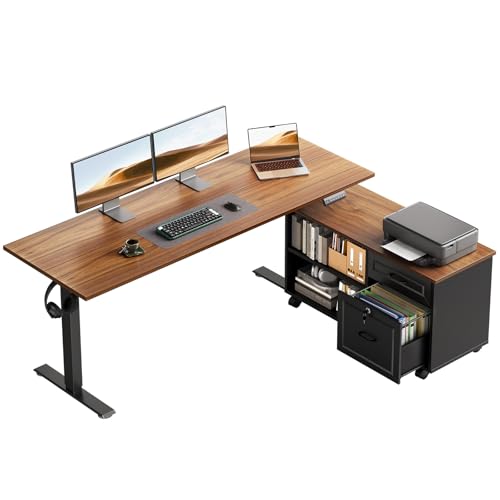
L Shaped Desk with File Drawers: The Complete Guide to a Clutter-Free Workspace
Everything you need to know before choosing an L shaped desk with integrated file drawers — storage capacity, ergonomic layout, material quality, and how to match one to your home office.
Explore Buying FactorsWhy an L shaped desk with file drawers? Corner desks already maximize floor space, but adding built-in file drawers turns that corner into a complete workstation. Instead of stacking paperwork on the desktop or buying a separate filing cabinet, you keep active documents within arm's reach — right where you sit. This guide walks you through the storage types, ergonomic considerations, material choices, and tier comparisons so you can shortlist the right model with confidence.
What Makes an L Shaped Desk with File Drawers Different
A standard corner desk gives you two work surfaces that meet at 90 degrees. When file drawers are integrated, usually into the return side or the main pedestal, the desk becomes a storage-and-work hybrid. The drawers are typically letter-size or legal-size, and most mid-range and high-end tier models use metal ball-bearing glides rather than plastic rollers. The key difference from a simple desk-with-drawers is drawer depth and load rating: file drawers need to support the weight of hanging folders, which demands a reinforced drawer box and a sturdier frame.
This design suits people who handle paperwork regularly — freelancers, small business owners, remote employees with tax documents, or anyone managing printed contracts. If your workflow is mostly digital, a model with a single file drawer plus a utility drawer usually offers a better balance than a desk dominated by two deep file drawers.
File Drawer Configurations to Consider
Single File Drawer
Best for light paperwork and buyers who want to preserve knee clearance. Usually paired with one or two utility drawers above it for stationery and small accessories.
Double File Drawers
Suits heavier document loads and shared workspaces. Look for full-extension slides so both drawers open completely, giving access to the back of the folder rows.
Lateral File Drawer
Wide rather than deep, ideal for letter and legal folders side by side. Often found on the main pedestal of premium models and easier to scan at a glance.
File Drawer + Hutch Combo
Adds overhead shelving above the return. Great for a full home office, but confirm the hutch height leaves enough room for your monitor and doesn't crowd the work surface.
If your paperwork volume is modest, a compact configuration with a single file drawer keeps the desk lighter and easier to move. For a home office where the desk doubles as a document archive, a lateral drawer on the main pedestal is often the most practical choice.
Key Buying Factors Before You Decide
1. Desk Depth and Monitor Placement
The return side of an L shaped desk is usually shallower than the main side. Before committing, measure the depth of the main surface where your monitor sits — a 24-inch depth is comfortable for a single display, while dual monitors benefit from 28 inches or more. The file drawer pedestal reduces knee room, so check that your chair still slides fully under the main work surface when the drawer is closed.
2. Reversible Orientation
Many corner desks ship in a fixed left or right orientation. A reversible design lets you install the return on whichever side matches your room's window, door, and outlet placement. This matters more than most buyers expect — an L shaped desk with file drawers that faces the wrong way can block natural light or force awkward cable routing. If your room layout is still flexible, a reversible model is the safer choice.
3. Drawer Glide and Frame Quality
Entry-level tier desks frequently use nylon rollers that wear out under the weight of hanging folders. Mid-range and high-end tier models typically use metal ball-bearing slides with a rated load capacity. The desk frame should also include a center support leg or cross brace on wider spans — file drawers add concentrated weight on one side, and a frame without reinforcement can develop a sag over time.
4. Material and Surface Durability
Engineered wood with a laminate or melamine finish is common and easy to maintain. Solid wood and butcher block tops are more durable for heavy use but add weight and require periodic care. If the desk sits near a window, a UV-resistant finish helps prevent fading. You can compare surface options in the broader guide to wood desktops before finalizing your choice.
5. Cable Management and Power
A corner desk with drawers often hides cables behind the drawer pedestal, which can make routing messy. Look for built-in grommets, a rear cable tray, or at least open space behind the drawers. Some models include built-in outlets or USB ports on the desktop — a genuine convenience if you charge devices at the desk. For heavier setups, see the guide to L shaped computer desks with cable management for routing ideas.
Measurement tip: Tape out the full L footprint on your floor before ordering. Confirm the return does not collide with a door swing or closet, and check that the drawer pedestal leaves at least 24 inches of clearance for your chair's base to rotate.
Comparing Desk Tiers: What Changes at Each Level
Rather than focusing on specific figures, it helps to understand how quality scales across market tiers. The table below describes what you can reasonably expect from each tier when shopping for an L shaped desk with file drawers.
| Tier | Drawer Hardware | Frame & Build | Best For |
|---|---|---|---|
| Entry-level | Nylon rollers, partial extension, one letter-size file drawer | Engineered wood panels, basic cross brace | Light paperwork, occasional home use, starter setups |
| Mid-range | Metal ball-bearing slides, full extension, one file + utility drawers | Reinforced steel frame, laminate top, reversible orientation | Daily home office use, moderate document volume |
| High-end tier | Heavy-duty slides, lateral file drawer, soft-close option | Thick top, welded frame, integrated cable tray and grommets | Frequent use, heavier storage, dedicated office room |
| Professional-grade | Commercial-rated slides, dual file drawers, lockable | Solid wood or high-grade laminate, center support leg | Small business, archival storage, shared workspaces |
Mid-range models generally offer the most balanced package for a home office: the drawer glides are smoother and more durable than entry-level hardware, and the frame is stiff enough to stay level under load. Professional-grade desks are a long-term investment suited to buyers who need lockable storage or handle legal-size folders regularly.
Ergonomics and Layout for a Corner Desk with Drawers
The drawer pedestal changes how you use the desk. Place your primary monitor on the main surface and angle the return side as a secondary work area for paperwork, a laptop, or a printer. Keep the file drawer nearest your chair so you can pull folders without twisting. If the desk is used for long sessions, check the seated height against your body — the office desk height calculator helps you confirm the right surface level before purchase.
Avoid placing the monitor directly over the drawer bank if the pedestal prevents your knees from fitting under the main surface. A common mistake is choosing a desk whose return is too deep, pushing the main work area too far back. Sit at a taped-out footprint first, then compare that experience to the desk's listed dimensions.
Getting the Most from the File Drawers
- Use letter-size hanging folders and label them by project or month — vertical filing is faster to scan than stacked piles.
- Keep the file drawer for active documents only; archive older paperwork elsewhere to avoid overloading the slides.
- Dedicate the utility drawer above the file drawer to stationery, chargers, and small accessories.
- Add a desktop file organizer for the few folders you use daily so you open the drawer less often.
- Route charging cables through a grommet rather than draping them across the drawer face.
Pairing the drawers with a small desktop organizer keeps the most-used items visible while the file drawer holds everything else. If space is tight, a compact desk file organizer can act as a staging area for the day's documents.
Ready to Compare Models?
Browse curated options below, filtered for L shaped desks with file drawers. Check availability, drawer configuration, and frame specifications before you commit.
Frequently Asked Questions
For related corner layouts, you may also find the comparison of L shaped desks with drawers and file cabinet useful if you are weighing integrated storage against a freestanding cabinet. And if paperwork volume is low, a 48-inch L shaped desk with drawers keeps the footprint tighter without sacrificing the corner work area.