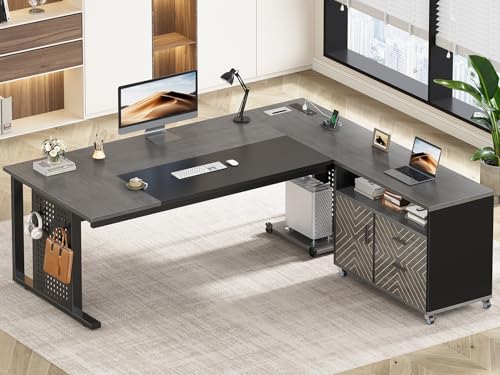
L-Shaped Desk with Drawers and File Cabinet: The Complete Workspace Guide
Maximize your corner, organize your documents, and build a home office that works as hard as you do. Learn how to choose, place, and maintain an L-shaped desk with integrated drawers and a file cabinet.
Explore Recommended ModelsWhy an L-shaped desk with drawers and file cabinet? If you are researching this configuration, you already know what you want: a corner workstation that provides expansive surface area for monitors, keyboard, and reference materials — while keeping paperwork and supplies tucked away. This guide answers the questions that come up before a purchase: how much space it needs, where the file cabinet should sit, which materials hold up over time, and how to keep the setup ergonomic. Everything here is designed to help you make a confident, informed decision.
Why Choose an L-Shaped Desk with Drawers and File Cabinet
An L-shaped desk with drawers and file cabinet solves the two biggest home office problems at once: limited work surface and scattered paperwork. The L-shape wraps around your corner, giving you a primary work zone and a secondary return for a second monitor, printer, or writing area. Integrated drawers hold everyday items — pens, chargers, notebooks — while the file cabinet keeps important documents in a dedicated, lockable space for many models. For anyone who works with contracts, invoices, or client records, having storage built into the desk reduces clutter and eliminates the need for a separate filing unit across the room.
If you are still weighing shapes, the broader guide to L-shaped desks with file drawers covers variations that emphasize drawer-only storage over a full cabinet. For small rooms, a 48-inch L-shaped desk with drawers delivers the same corner efficiency in a tighter footprint.
Expansive Work Surface
The corner layout creates two connected work zones, ideal for dual monitors, a laptop, and reference documents without feeling cramped.
Dedicated File Storage
A built-in file cabinet keeps hanging folders, contracts, and archives organized and within arm's reach of your seated position.
Drawer Organization
Shallow utility drawers handle stationery, cables, and small devices, keeping the desktop clear for actual work.
Corner Efficiency
Uses otherwise dead corner space, making it a smart choice for bedrooms, studios, and compact home offices.
Ergonomic Layout
The return side lets you angle a second monitor or place a keyboard tray, reducing reach and strain during long sessions.
Integrated Cable Routing
Many models include grommets and under-desk channels to tame monitor and charging cables at the source.
What to Look For Before You Buy
Not every L-shaped desk with a file cabinet is built to the same standard. The checklist below covers the specifications that matter most when you compare models side by side.
- Corner footprint: Measure both wall runs. Standard models span roughly 60–70 inches per side; compact versions fit 48-inch corners.
- File cabinet type: Letter-size hanging files are the most common; some cabinets support legal-size folders. Confirm the drawer depth and glides.
- Drawer construction: Metal ball-bearing slides last longer than plastic rollers, especially in drawers used daily.
- Weight capacity: Check the load rating for both the desktop and the file drawer. Heavy-duty frames matter if you use multiple monitors or a printer on the desk.
- Reversible orientation: A reversible L-shape lets you place the return on the left or right, which matters in narrow rooms.
- Material and finish: Laminate and veneer offer scratch resistance at the mid-range tier; solid wood is a long-term investment with premium durability.
- Cable management: Look for grommets, modesty panels, or under-desk trays that keep cords out of sight.
- Assembly complexity: Desks with pre-drilled panels and labeled hardware are far easier to assemble alone.
Comparing L-Shaped Desk Configurations
Use this table to match the desk configuration to your work style and room size. Descriptors reflect market positioning and build quality, not numerical figures.
| Configuration | Tier | Best For | Key Consideration |
|---|---|---|---|
| Compact L-shape with file cabinet | Entry-level | Small bedrooms and apartments | Verify the corner span fits your wall before ordering |
| Reversible L-shape with drawers | Mid-range | Flexible room layouts | Return side can be flipped left or right during assembly |
| L-shape with hutch and file cabinet | High-end tier | Document-heavy professional work | Hutch adds vertical storage but reduces monitor clearance |
| Solid wood L-shape with file drawers | Premium | Long-term home office investment | Heavier and requires two people for assembly |
| L-shape with built-in outlets | Professional-grade | Tech-heavy multi-device setups | Confirm outlet placement does not conflict with monitor arms |
For a version that prioritizes shelving over a cabinet, the L-shaped desk with hutch and shelves offers open storage and a lighter visual profile. If you need both a hutch and a filing cabinet, the L-shaped desk with hutch and file cabinet combines vertical and document storage in one footprint.
Placement and Ergonomics: Getting the Corner Right
Where you place the file cabinet and how you angle the return directly affect comfort. Position the main work surface along the longer wall, with the file cabinet on the return side or tucked beneath the desktop where it does not block legroom. Keep the monitor at roughly arm's length and slightly below eye level; the corner geometry of an L-shaped desk makes this easier because you can angle the screen away from glare. If you plan to add a keyboard tray, the L-shaped desk with drawers and keyboard tray configuration keeps the typing surface separate from the main desktop.
For standing or sit-to-stand use, a height-adjustable model changes the calculus — check the L-shaped desk that raises and lowers guide, and confirm your chair matches the range with the adjustable-height desk chair for standing desk. A monitor stand can also lift your screen without occupying drawer space: see the desk monitor stand recommendations.
Organizing Drawers and the File Cabinet
A file cabinet only helps if it stays organized. Assign the top drawer to active documents and the lower drawer to archives. Use drawer dividers for stationery and keep cables in labeled bins. For desk-level organization, a desk file organizer handles items that need to be visible, while small desk storage solutions add capacity without expanding the footprint. If the desk sits on hardwood, protect the floor with an under-desk chair mat for hardwood floors.
A clean aesthetic also matters. Coordinate your finish with the room using the desk color scheme guide, and add a desk mat to protect the surface from scratches and keyboard wear.
Related L-Shaped Desk Configurations
Depending on your room and workload, other L-shaped variants may fit better. The L-shaped desk with drawers for small space is designed for tight corners. If power access is a priority, consider the L-shaped computer desk with power outlet. For cable-heavy setups, the L-shaped computer desk with cable management includes routing built into the frame. A dedicated L-shaped computer desk with file cabinet focuses storage on documents, while the L-shaped computer desk with drawers and shelves adds open display space.
If you work from home, the L-shaped desk for home office with drawers is tailored to daily professional use. Gamers who also work at the same station may prefer the L-shaped desk for gaming and work. And if your office is genuinely small, the L-shaped desk for small home office guide narrows the options further.
Materials and Durability
The desk surface and cabinet construction determine how the furniture ages. Laminate and engineered wood with veneer are common at the mid-range tier and resist scratches and moisture well. Solid wood — oak, walnut, maple — sits at the premium tier and can be refinished if damaged. Metal frames with wood tops combine heavy-duty support with a contemporary look. Whichever you choose, confirm the file drawer glides are metal rather than plastic if the cabinet will be opened daily. For surface-specific advice, the wood desktops guide covers finish and care in detail.
Frequently Asked Questions
What are the benefits of an L-shaped desk with drawers and a file cabinet?
It combines expansive work surface with dedicated document storage and everyday drawer organization. The corner layout uses otherwise wasted space and keeps files within arm's reach, reducing clutter and the need for a separate filing unit.
How much floor space does an L-shaped desk with file cabinet require?
A standard model typically needs a corner footprint of roughly 60 to 70 inches on each side. Compact configurations fit into 48-inch corners, making them suitable for bedrooms and studio apartments.
Where should the file cabinet be positioned on an L-shaped desk?
Place it on the return side or beneath the main work surface where it does not obstruct legroom. Keeping it within reach of your seated position improves workflow and reduces unnecessary movement.
Can an L-shaped desk with drawers and file cabinet support multiple monitors?
Yes. The generous corner surface comfortably supports dual or triple monitor setups. A monitor stand or arm frees up drawer access while maintaining ergonomic viewing distance.
What materials work best for an L-shaped desk with drawers and file cabinet?
Engineered wood with laminate or veneer offers durability and a consistent finish for mid-range models. Solid wood such as oak, walnut, and maple delivers premium longevity. Metal frames with wood tops combine heavy-duty support with a modern aesthetic.
Ready to Build Your Corner Workspace?
Compare recommended L-shaped desks with drawers and file cabinets below. Each listing opens directly to the retailer so you can verify dimensions, drawer configuration, and availability for your room.
View Recommended Desks