Standing Desk Height Guide: Find Your Perfect Ergonomic Setup
Stop guessing your standing desk height. Use our proven formula to align your body, boost energy, and work pain‑free.
Calculate Your Ideal HeightWhy correct standing desk height matters: A poorly adjusted standing desk can cause back pain, neck strain, and fatigue. This guide gives you the exact formula to find your optimal height, plus pro tips for a seamless sit‑stand transition.
The Perfect Height Formula
Your standing desk height should be elbow height (in a 90° angle) + 1–2 inches (2.5–5 cm) for natural wrist posture.
Start by standing tall with your arms relaxed. Bend your elbows to 90° and keep your forearms parallel to the floor. The distance from the floor to the bottom of your forearm is your ideal desk top height. For most people, this falls between 38–46 inches (96–117 cm).
Step‑by‑Step Desk Height Setup
- Stand naturally: Wear your regular work shoes. Stand with feet hip‑width apart, shoulders back.
- Bend elbows to 90°: Relax your shoulders. Your elbows should be close to your torso.
- Measure from floor to forearm: Use a tape measure from the floor to the underside of your forearm (just below the elbow).
- Adjust your desk: Set your standing desk to that measurement. Then fine‑tune by raising or lowering ¼ inch until your wrists are straight while typing.
- Check your screen height: The top of your monitor should be at or slightly below eye level. Use a monitor stand with storage if needed.
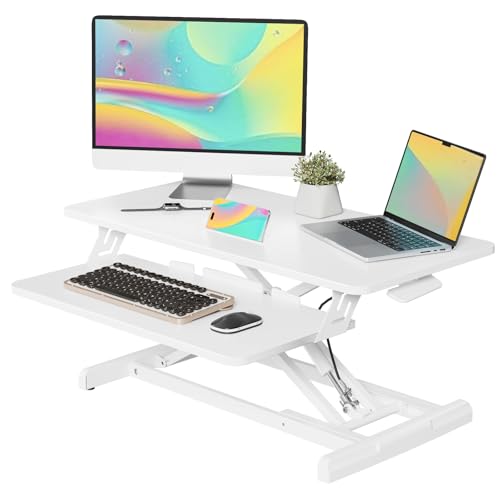
Once your desk height is set, ensure your office chair is adjusted for sitting mode, and consider a standing desk with keyboard tray for extra flexibility.
3 Common Height Mistakes (and How to Fix Them)
❌ Desk too high
Your shoulders will hunch, causing neck and shoulder pain. Fix: Lower the desk so your forearms are parallel to the floor. Use a under‑desk keyboard tray mount if your desk can’t go lower.
❌ Desk too low
You’ll lean forward, straining your lower back and wrists. Fix: Raise the desk until your elbows are at 90°. Consider a standing desk converter for laptop if your current desk is fixed.
❌ Monitor misaligned
Even with correct desk height, a low monitor forces your neck down. Fix: Use a monitor arm desk mount to position the screen at eye level.
Sit‑Stand Transition: The 20‑8‑2 Rule
Alternate between sitting and standing every 20 minutes sitting, 8 minutes standing, 2 minutes moving. This keeps your circulation active and prevents fatigue. For a seamless transition, invest in an electric standing desk with drawer or a sit‑stand desk with adjustable keyboard tray.
Accessories That Perfect Your Height
Reduces leg strain while standing.
For seated posture support.
Keeps wrists neutral while typing.
Need a complete setup? Browse our home office desk setup ideas for inspiration.
Quick Height Reference (Based on User Height)
| Your Height | Desk Height (approx.) | Monitor Top Height |
|---|---|---|
| 5'0" – 5'3" (152–160 cm) | 36–38" (91–96 cm) | 44–46" (112–117 cm) |
| 5'4" – 5'7" (162–170 cm) | 38–40" (96–102 cm) | 46–48" (117–122 cm) |
| 5'8" – 5'11" (172–180 cm) | 40–42" (102–107 cm) | 48–50" (122–127 cm) |
| 6'0" – 6'3" (183–191 cm) | 42–44" (107–112 cm) | 50–52" (127–132 cm) |
*These are starting points. Always fine‑tune based on your personal comfort.
Ready to elevate your workspace?
Now that you know your perfect standing desk height, explore our top‑rated electric standing desks with monitor mounts or standing desk converters for dual monitors. Click the button below to see the best options hand‑picked by our team.
Shop Recommended Standing Desks