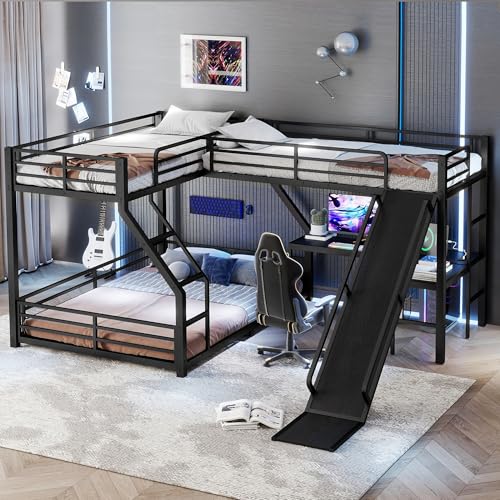
Twin Over Full L Shaped Bunk Bed with Desk: The Ultimate Space-Saving Solution
Discover how an L shaped bunk bed with a built-in desk combines sleeping space for two or three with a dedicated study zone—perfect for shared bedrooms, guest rooms, and multifunctional family spaces.
Explore the Complete GuideWhy consider a twin over full L shaped bunk bed with desk? This configuration solves one of the most common household dilemmas: fitting comfortable sleeping arrangements for multiple people alongside a functional workspace without overwhelming the room. The L-shaped footprint hugs a corner, freeing up central floor space for play, movement, or storage. Below, we break down everything you need to know before choosing one—layout logic, safety standards, material differences, and practical buying considerations.
What Exactly Is a Twin Over Full L Shaped Bunk Bed with Desk?
A twin over full L shaped bunk bed with desk is a multi-tier furniture system that stacks a twin-size bed above a full-size bed and extends outward with an attached desk, forming an L-shaped silhouette that typically fits into a room corner. Unlike a straight bunk bed, the L configuration uses perpendicular placement to maximize wall space and create distinct functional zones—sleeping above, sleeping below, and working or studying on the extended arm of the L.
This design is especially popular in homes where a single bedroom must serve multiple purposes: children sharing a room, a guest room that doubles as a home office, or a teenager's bedroom that needs a dedicated homework station. The integrated desk eliminates the need for a separate study table, which is a significant advantage in compact rooms.
Compared with traditional bunk beds, the L-shaped variant distributes weight across a wider base, which often translates to greater stability. The desk section can be positioned on either the left or right side depending on the model, so orientation flexibility is a key buying consideration. If you are exploring related configurations, you might also review options like a twin over full bunk bed with desk and drawers or a twin over full bunk bed with stairs and desk for alternative access and storage solutions.
Key Benefits of Choosing This Configuration
1. Exceptional Space Efficiency
The most obvious advantage is floor-space savings. By stacking two beds and integrating a desk into the same footprint, you consolidate three major furniture pieces—two beds and a workspace—into one cohesive unit. The L shape takes advantage of underused corner real estate, which is often difficult to furnish with standalone pieces.
2. Built-In Study or Work Zone
The attached desk provides a dedicated surface for homework, crafts, or computer work. Because the desk is part of the bed structure, it stays stable and saves you from sourcing a separate table that may not fit the room's dimensions. Many models include cable management cutouts or under-desk shelving, making the workspace more functional.
3. Versatile Sleeping Capacity
A twin over full configuration sleeps two comfortably—one on the twin upper bunk and one on the full lower bed—and can accommodate a third person on the full bed if needed. This makes it ideal for siblings sharing a room, sleepovers, or hosting guests while preserving a workspace during the day.
4. Defined Zones in Shared Rooms
The L shape naturally creates visual separation between the sleeping area and the study area. This helps establish routine and privacy even in an open-plan bedroom, which is particularly valuable for teenagers or students who need a focused environment.
5. Design Cohesion
Because the beds and desk are one integrated unit, the room looks intentional and coordinated rather than cluttered with mismatched furniture. Many models are available in finishes that match common bedroom aesthetics, from modern metal to warm wood tones.
Layout and Dimension Considerations
Before committing to a twin over full L shaped bunk bed with desk, measure your room carefully. The L footprint means the unit extends along two walls, so corner placement is usually the intended setup. Key measurements to verify include:
- Ceiling height: Ensure adequate clearance above the upper twin bunk so the sleeper can sit up without hitting the ceiling. A minimum of 30 to 36 inches between the top mattress and the ceiling is a common guideline.
- Corner clearance: Confirm that doors, windows, closets, and air vents are not blocked by the desk arm or the ladder position.
- Desk orientation: Decide whether you need the desk on the left or right side of the L. Some models are reversible; others are fixed.
- Ladder placement: The ladder should not obstruct walkways or the desk chair zone. Check whether the ladder can be positioned at either end of the upper bunk.
- Mattress thickness: For the upper twin bunk, use a mattress no thicker than 8 inches to preserve guardrail safety. The lower full bed can typically accept a standard full-size mattress.
For rooms with unusual proportions, an twin over queen bunk bed with desk may offer additional lower-bed space, while a twin size bunk bed with desk suits tighter footprints. If you are comparing loft-style alternatives, the twin loft bed with desk is another space-saving direction worth reviewing.
Materials and Construction Quality
The durability and safety of your bunk bed depend heavily on the materials used. Here is a comparison of common construction types:
| Material Type | Durability Tier | Key Characteristics | Best For |
|---|---|---|---|
| Heavy-duty steel / metal | High-end tier | Reinforced frame, rust-proof finish, high weight capacity, minimal flex | Long-term use, older children and teens, high-traffic rooms |
| Solid hardwood (oak, maple, pine) | Premium tier | Durable construction, natural grain, repairable surface | Warm aesthetic, family heirloom potential |
| Engineered wood (MDF, particle board) | Mid-range tier | Uniform finish, lighter weight, requires careful assembly | Controlled environments, decorative finishes |
| Mixed metal-and-wood combinations | Balanced tier | Metal frame with wood accents, visual contrast | Modern or industrial-style bedrooms |
When evaluating construction, pay attention to joint quality, the thickness of bed rails, and whether the desk surface is reinforced to resist sagging. A commercial-grade steel frame with a powder-coated finish generally offers the best combination of longevity and stability for a twin over full L shaped bunk bed with desk. For more desk-specific material guidance, see our broader resources on top desks and top desk selections.
Essential Safety Features to Check
Safety is paramount in any bunk bed, and the twin over full L shaped configuration introduces a few specific considerations. Use this checklist when evaluating models:
Safety Verification Checklist
- Full-length guardrails on the upper twin bunk—at least 5 inches above the mattress top, with no gaps larger than a few inches that could trap a limb.
- Secure, anti-slip ladder—wide treads, a handrail if possible, and attachment points that do not rely on hooks alone.
- Reinforced corner joints—look for metal-to-metal connections, bolts with lock washers, or mortise-and-tenon joinery in wood frames.
- Weight capacity disclosure—a reputable manufacturer will clearly state the maximum load for both bunks.
- Stable L-footprint—the extended desk arm should anchor to the wall or include anti-tip hardware for added security.
- No sharp edges or exposed hardware—especially at desk height and along the ladder path.
- Compliant with relevant safety standards—such as ASTM F1427 for bunk beds, where applicable.
Always assemble the bed strictly according to the manufacturer's instructions, and periodically check bolts and fasteners for tightness. If the bed is used by younger children, consider additional wall anchoring for the desk side of the L.
Desk Integration: What to Expect
The desk portion of these units varies significantly in size and feature set. Entry-level models often provide a simple rectangular surface adequate for a laptop and notebook, while premium tiers may include built-in shelving, cable management grommets, and even a hutch. Consider the following when assessing the desk:
- Surface area: Verify that the desk depth accommodates your intended use—at least 20 inches for a monitor or laptop, more if you need textbooks or a printer.
- Height: The desk height should suit the primary user. Standard desk height is around 28 to 30 inches, but bunk-integrated desks sometimes sit lower or higher.
- Under-desk space: Check knee clearance and whether a chair can tuck in without hitting the bed frame.
- Storage: Look for drawers, shelves, or cubbies integrated into the desk arm. For additional organization ideas, browse our under desk storage and under desk drawers guides.
- Cable management: Pre-drilled holes or clips are a major convenience. See our under desk cable management resources for best practices.
If you prefer a dedicated desk separate from the bed, a teenage bedroom furniture with desks collection may offer more flexibility. However, for maximum space efficiency, the integrated approach remains hard to beat.
How to Choose the Right Model for Your Home
With so many configurations on the market, narrowing down the right twin over full L shaped bunk bed with desk comes down to a few practical filters:
- Room dimensions and layout: Measure the corner where the bed will sit. Confirm the L arm length against door swings and window positions.
- Primary users' ages and sizes: Younger children benefit from lower overall height and wider guardrails; teens and adults need higher weight capacity and a desk sized for serious study.
- Material and finish: Match the bed to the room's existing decor. Metal frames suit modern or industrial themes; wood tones suit traditional and transitional styles.
- Storage needs: If clutter is a concern, prioritize models with built-in drawers or shelves. Related configurations like a twin over full bunk bed with desk and drawers may be worth comparing.
- Assembly complexity: Some units require two people and several hours to assemble. Check whether the manufacturer offers clear instructions and labeled parts.
- Longevity and repairability: Solid wood and heavy-duty steel frames tend to outlast engineered wood. Consider whether replacement parts are available.
For smaller rooms, a twin size loft bed with desk and storage may be a better fit, while a twin loft bed with desk and drawers offers a different balance of sleeping and storage. The key is matching the footprint to your actual available space rather than assuming one size fits all.
Care and Maintenance Tips
To keep your twin over full L shaped bunk bed with desk in good condition for years:
- Tighten all bolts and fasteners every few months, especially during the first year of use.
- Wipe desk surfaces regularly with a mild cleaner appropriate for the material (avoid harsh abrasives on laminate or veneer).
- Use a mattress protector on both bunks to prevent spills from reaching the frame.
- Inspect guardrails and ladder connections periodically for wear or loosening.
- Avoid placing heavy items on the upper bunk beyond the specified weight limit.
- Keep the desk free of unnecessary clutter to preserve the workspace's function and reduce strain on the integrated surface.
For broader desk surface care advice, see our guides on protect desk surface and clean wood desks.
Frequently Asked Questions
What is a twin over full L shaped bunk bed with desk?
It is a multi-functional furniture unit that combines a twin upper bunk, a full lower bed, and an attached desk arranged in an L-shaped footprint. The L configuration fits into a corner, maximizing floor space while providing sleeping areas for two or three people plus a dedicated study or work zone.
How much weight can a twin over full L shaped bunk bed with desk support?
Weight capacity varies by model, but most quality units support roughly 200 to 250 pounds on the upper twin bunk and 400 to 500 pounds on the lower full bed. Always check the manufacturer's stated limits and ensure the frame uses heavy-duty steel or solid hardwood for safety.
Is this type of bunk bed safe for children?
Yes, when properly assembled and used according to guidelines. Look for full-length guardrails on the upper bunk, a secure ladder with anti-slip steps, and sturdy frame construction. The L-shaped design distributes weight across a wider footprint, which can enhance stability compared with traditional stacked bunks.
What mattress sizes are needed?
You need one twin-size mattress for the upper bunk and one full-size mattress for the lower bed. For safety, use a mattress no thicker than 8 inches on the top bunk to maintain adequate guardrail height. Most models accommodate standard twin and full mattress dimensions.
How do I choose the right model for my room?
Measure your room carefully, including ceiling height, door clearances, and window placement. Confirm the desk side and bed orientation match your layout. Consider the age of users, weight capacity, material durability, and whether you need additional storage. Also verify that the ladder position does not block traffic flow.