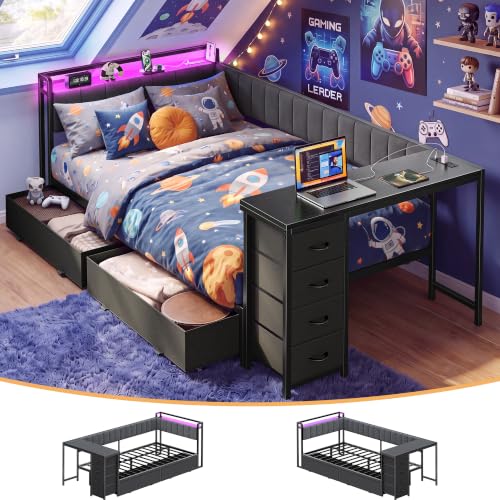
Twin Bed with Desk: Space-Saving Solutions for Small Rooms
Learn how twin bed and desk combinations reclaim floor space, support productivity, and create a functional sleeping and working zone in compact bedrooms, guest rooms, and studio apartments.
EXPLORE BUYING GUIDEWhy a twin bed with desk makes sense: Combining a twin-size sleeping surface with an integrated workspace consolidates two essential furniture pieces into a single footprint. For students, remote workers, and anyone living in a compact room, this configuration preserves floor area while delivering a dedicated place to sleep, study, and work. The key is choosing the right configuration and understanding the trade-offs before you commit.
What Exactly Is a Twin Bed with Desk?
A twin bed with desk is a multi-functional furniture piece that merges a twin-size mattress platform (typically 38 inches wide by 75 inches long) with a built-in or attachable workspace. Unlike placing a separate desk next to a standard bed, these combinations are engineered as a single unit, which means the desk and sleeping surface share a structural frame and a unified footprint.
The concept appears in several distinct formats. Each format solves a slightly different spatial problem, and understanding the differences is the first step toward choosing the right one for your room.
The Core Configurations
The most common formats include:
- Twin loft bed with desk: The sleeping surface is elevated, and a desk occupies the space underneath. This is the most space-efficient configuration because it uses vertical volume rather than floor area.
- Twin bunk bed with desk: A bunk arrangement where one level is a sleeping surface and another level incorporates a desk, often with drawers or shelving integrated alongside.
- Twin murphy bed with desk: A wall-mounted bed that folds up to reveal or expose a desk surface. This configuration is ideal for rooms that serve multiple purposes and need to transition between uses.
- Low loft twin bed with desk: A gentler elevation than a full loft, placing the desk at a comfortable seated height while keeping the overall structure closer to the floor.
Who Benefits Most from a Twin Bed with Desk?
These combinations are not limited to children's rooms, although they are popular there. The broader appeal comes from the fact that many modern living situations demand furniture that performs more than one function.
Students and Teenagers
For students, a bedroom often doubles as a study space. A twin loft bed with desk places the study zone directly beneath the sleeping area, keeping homework materials organized and within reach. Parents appreciate that the configuration encourages a separation between rest and work without requiring an additional room. Many models include shelving and drawers, which helps manage books, supplies, and personal items. If you are furnishing a teenager's room, exploring broader teenage bedroom furniture with desks can help you coordinate the rest of the layout.
Adults in Compact Homes
Adults living in studio apartments, guest rooms, or small urban homes also benefit. A twin loft bed with desk for adults is built with higher weight capacities and desk surfaces sized for full-time computer work. For remote workers who need a dedicated workstation but cannot spare an entire room, these configurations create a legitimate home office without sacrificing a comfortable place to sleep.
Guest Rooms and Multipurpose Spaces
In a guest room that also serves as a home office, a twin murphy bed with desk allows the room to function as a workspace during the day and a sleeping area at night. The bed folds away, and the desk becomes the primary surface. This flexibility is valuable in homes where every square foot must earn its place.
Comparing Twin Bed with Desk Configurations
The table below summarizes the primary configurations, their spatial characteristics, and the situations where each tends to work best. Use it as a starting point for narrowing down your options.
| Configuration | Best For | Space Characteristic | Tier Consideration |
|---|---|---|---|
| Twin loft bed with desk | Small bedrooms, students, adults in studios | Uses vertical space; desk sits beneath the bed | Entry-level to premium depending on frame material and desk build |
| Twin bunk bed with desk | Shared rooms, siblings, sleepovers | Two sleeping levels with a desk integrated into one side | Mid-range to high-end tier for solid wood and reinforced frames |
| Twin murphy bed with desk | Guest rooms, home offices, multipurpose rooms | Bed folds away; desk remains accessible when bed is stored | Premium to luxury tier due to wall-mount hardware and mechanism quality |
| Low loft twin bed with desk | Younger children, rooms with lower ceilings | Moderate elevation; easier access than full loft | Starter tier to mid-range; safety rails and ladder design vary |
Key Features to Evaluate Before You Choose
Not all twin bed with desk combinations are built to the same standard. The differences that matter most often come down to structural integrity, desk usability, and how well the unit fits your room's dimensions.
Frame Construction and Weight Capacity
The frame determines how stable the entire unit feels, especially for loft and bunk configurations. Metal frames with reinforced joints tend to offer consistent strength and are common in mid-range and high-end tier products. Solid wood frames, such as pine or hardwood, provide a warmer aesthetic and can be very durable when properly joined. Engineered wood with laminate finishes is typical of entry-level and starter tier options; these can work well for lighter use but may not match the longevity of solid construction.
Always check the stated weight capacity for both the sleeping surface and the desk. A desk that flexes under the weight of a monitor and keyboard is a daily annoyance; a frame that feels unstable undermines sleep quality.
Desk Surface Dimensions and Depth
A desk integrated into a bed frame is often shallower than a freestanding desk. Measure the depth carefully: a surface depth of at least 20 inches is generally needed to accommodate a monitor, keyboard, and mouse without feeling cramped. Some loft configurations offer deeper surfaces, while bunk-integrated desks tend to be more compact.
Consider the height of the desk relative to the sleeping platform. In a loft setup, the desk height should allow comfortable seated posture with adequate clearance above your head. If the clearance is too tight, the workspace will feel confining regardless of surface area.
Storage and Organization
Many twin bed with desk units incorporate drawers, shelves, or cubbies. These additions reduce the need for separate storage furniture, which further preserves floor space. A desk with an integrated drawer or two can keep office supplies out of sight, while shelving above or beside the desk provides vertical storage for books and decor. If organization is a priority, look for models that balance desk surface area with practical storage rather than maximizing one at the expense of the other.
Safety Features for Loft and Bunk Configurations
Elevated sleeping surfaces require guardrails and a stable ladder or stair system. Guardrails should extend sufficiently above the mattress to prevent accidental rolls. Ladders should be securely attached and have treads that are comfortable to climb. For children's rooms, these safety elements are non-negotiable. For adult use, they are still important, particularly in smaller rooms where the ladder may be used frequently.
Assembly and Room Fit
Loft and bunk beds are typically delivered flat-packed and require assembly. Review the assembly requirements before purchasing: some units are straightforward, while others involve many steps and two people. Also measure your ceiling height. A full loft requires enough vertical clearance for a person to sit comfortably at the desk and for the mattress to sit safely below the ceiling. Low lofts are more forgiving in rooms with standard or slightly lower ceilings.
Advantages and Trade-Offs
Like any furniture decision, a twin bed with desk involves balancing benefits against limitations. Understanding both sides helps you make a choice you will not regret.
Advantages
- Consolidates sleeping and working areas into one footprint
- Frees floor space for movement and other activities
- Encourages a dedicated study or work zone
- Many models include storage that replaces separate furniture
- Available across entry-level, mid-range, and premium tiers
Trade-Offs
- Integrated desks are often shallower than freestanding desks
- Loft configurations require ceiling clearance and ladder use
- Assembly can be time-consuming
- Less flexibility to rearrange furniture later
- Desk height may not suit every user's ergonomic needs
Buying Guide: How to Choose the Right Twin Bed with Desk
With the configurations and features in mind, the selection process becomes more manageable. The following steps outline a practical approach.
Step 1: Measure the Room and Ceiling
Start with the room's floor dimensions and ceiling height. Sketch a simple floor plan and mark where the bed-desk unit will sit. Confirm that doors, windows, and closets remain accessible. For loft configurations, measure the distance from floor to ceiling and subtract the height of the sleeping platform and mattress to determine seated clearance at the desk.
Step 2: Decide on the Configuration
Choose between loft, bunk, murphy, or low loft based on your room's constraints and your daily routine. A loft maximizes floor space; a murphy maximizes flexibility; a bunk suits shared rooms; a low loft suits younger children or lower ceilings.
Step 3: Prioritize Desk Usability
Check the desk surface depth, width, and height. If you use a monitor, ensure the surface can accommodate it at a comfortable viewing distance. If you use a laptop, confirm there is room for a mouse and a notebook. Small details, such as cable management cutouts or grommets, make a difference in daily use.
Step 4: Evaluate Construction Quality
Look for reinforced joints, sturdy ladder attachment points, and clear weight capacity ratings. Metal frames with powder-coated finishes resist wear; solid wood frames offer warmth and repairability; engineered wood is consistent but varies in durability across tiers. Read owner feedback about stability and long-term wear when available.
Step 5: Consider the Tier and Long-Term Use
An entry-level unit can serve a child's room well for several years. A mid-range or high-end tier unit with solid construction is a better fit for daily adult use or for a room that will see many years of service. If the bed-desk combo will anchor a home office, treat it as a long-term investment and favor construction quality over cosmetic extras.
Setup and Organization Tips for a Bed-Desk Combo
Once the unit is assembled, a few thoughtful choices make the space more comfortable and productive.
- Position the desk for light: If possible, orient the desk so that natural light falls from the side rather than directly in front of or behind the monitor.
- Manage cables early: Loft and bunk configurations often route cables near the frame. Use cable clips or a small tray to keep cords tidy and out of the sleeping area. For more ideas, see under desk cable management.
- Add a task light: A clamp-on or compact desk lamp compensates for the reduced ambient light under a loft platform.
- Keep the sleep zone distinct: Avoid storing work materials on the bed. A clear boundary between rest and work supports better sleep and focus.
- Use vertical storage: Wall-mounted shelves or a small organizer on the desk keeps frequently used items within reach without crowding the surface.
Related Configurations Worth Exploring
If a standard twin bed with desk does not quite match your needs, several related formats offer similar benefits with different spatial trade-offs.
- Twin loft bed with desk and storage adds drawers or shelving for a more complete furniture solution.
- Twin loft bed with desk and drawers prioritizes concealed storage beneath the sleeping platform.
- Twin bunk bed with desk and drawers suits shared rooms where two sleepers need storage.
- Twin murphy bed with desk is ideal for rooms that must switch between office and guest use.
- Twin size loft bed with desk covers the core loft format in more detail.
- Twin low loft bed with desk offers a gentler elevation for younger users or lower ceilings.
- Twin over full bunk bed with desk and drawers combines a larger lower sleeping surface with a workspace.
- Twin loft bed with stairs and desk replaces a ladder with stairs for easier access.
Frequently Asked Questions
What is a twin bed with desk?
A twin bed with desk is a space-saving furniture combination that pairs a twin-size sleeping surface with an integrated workspace. Common configurations include loft beds with a desk underneath, bunk beds with a desk on one level, and murphy beds that fold away to reveal a desk.
Is a twin bed with desk suitable for adults?
Yes. Many twin loft beds with desk configurations are built for adult use, with weight capacities and desk dimensions designed for full-time work. Adults living in studio apartments, guest rooms, or compact homes often benefit from these setups. Check the stated weight capacity and desk clearance before choosing.
How much space does a twin bed with desk save?
A twin bed with desk typically consolidates two separate furniture footprints into one, freeing up floor area equivalent to a full desk and chair. In small rooms, this can reclaim a substantial portion of usable floor space while preserving a dedicated sleep and work zone.
What should I check before buying a twin bed with desk?
Verify ceiling height for loft configurations, measure the room's floor footprint, confirm the desk surface depth is adequate for your monitor and keyboard, check weight capacity ratings, and review assembly requirements. Also consider whether the desk orientation suits your workflow and whether storage elements are included.
Can a twin bed with desk be used in a guest room?
Yes. A twin murphy bed with desk is particularly well suited to guest rooms because the bed folds away when not in use, allowing the room to serve primarily as a workspace. Loft configurations can also work in guest rooms if the room has adequate ceiling height.
What is the difference between a loft and a bunk bed with desk?
A loft bed elevates a single sleeping surface and uses the space underneath for a desk or storage. A bunk bed stacks two sleeping surfaces, with a desk often integrated into one side or below. Lofts suit solo occupants; bunks suit shared rooms.