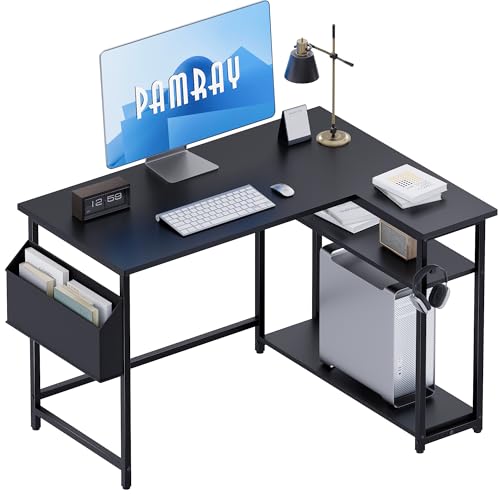
What Defines an L Shaped Desk with a Short Right Side
An L shaped desk with a short right side is an asymmetric corner workstation where the return — the secondary surface extending from the main desktop — points to your right and is deliberately shorter than the primary work surface. Instead of two equal-length arms forming a symmetrical L, the desk prioritizes one long run and trims the other.
In practice, the proportions usually look like this: the main section spans the wall in front of you, while the short right return turns the corner at a 90-degree angle and extends only far enough to hold a printer, a second monitor at an angle, or a small writing zone. The shorter arm keeps the footprint compact, which matters enormously in bedrooms, studio apartments, and narrow home offices.
The orientation is important and not universally interchangeable. On a fixed-orientation model, the return is built for the right side only. If your room requires the return on the left, you need a reversible model or a mirror-image version. If you are still mapping out your room, the broader guide to an L shaped desk with one side shorter covers how to choose which arm should be trimmed.
Short Return vs. Standard Return vs. Symmetrical L
The distinction is practical rather than cosmetic. A full-length return on both arms essentially creates a U-shaped footprint in a corner, which consumes significant floor area. A short return keeps the primary desk depth intact but narrows the secondary arm, reducing the amount of room the desk claims on one side. Compared with a straight desk, you still gain the wraparound corner benefit — more usable surface without pushing the desk farther into the middle of the room.
For buyers comparing shapes, the wider category of L shaped desks for home office use is worth reviewing, since the short-return variant is essentially a space-optimized member of that family.
Why Choose the Short Right Return
The short right side exists to solve a specific spatial conflict. Understanding that conflict helps you decide whether this layout is the right fit or whether a different asymmetric configuration suits you better.
Room Constraints That Favor a Short Return
- Door or walkway on the right: A full return would block circulation. A short arm leaves clearance while still turning the corner.
- Window or radiator on the right wall: The short return avoids placing a work surface against or over a heat source or glazing.
- Bedroom or studio apartment: Floor area is precious, and the trimmed return limits how much the desk intrudes into the sleeping or living zone.
- Narrow alcove or recess: The asymmetric footprint slots into a corner where a symmetrical L would not physically fit.
The Functional Trade-Off
What you give up is under-return storage and elbow room on the right. A short return typically cannot host a full file pedestal beneath it, and the depth on that arm is often shallower. What you gain is a cleaner circulation path, better visual balance in a small room, and a desk that still wraps around you enough to keep reference materials within arm's reach.
If storage is your primary concern rather than floor space, a model with a fuller return and integrated storage may serve you better — for example an L shaped desk with lots of storage. The short-right layout is a floor-space solution first and a storage solution second.
Specifications That Matter
Before comparing any two short-right models, lock down these dimensions and construction details. They determine whether the desk fits your room and whether the short arm will hold up over years of use.
Dimensional Values to Record
- Main surface length: Typically the long wall-facing section; this is where your primary monitor and keyboard live.
- Main surface depth: 23.6 to 29.5 inches is common; deeper is better for monitor arms.
- Right return length: The short arm; often 28–39 inches on compact models.
- Right return depth: Frequently shallower than the main surface — verify it can hold your intended secondary device.
- Overall corner footprint: Measure the diagonal distance and both wall runs in your room before ordering.
- Height range: Fixed-height models usually sit around 28–30 inches; adjustable models offer a wider span.
- Weight capacity on the short arm: Check specifically, since the short return is often rated lower than the main surface.
Construction Details to Verify
Confirm the frame material, the return's support method, the edge banding on the short arm, and whether the desk ships as a fixed-orientation or reversible build. For a deeper structural comparison across surface materials, the L shaped wood desk overview discusses how engineered wood, laminate, and solid timber behave under corner loads.
Quality Tiers Compared
Because the short right return is a space-driven design, models cluster into recognizable quality tiers. The table below uses universal tier descriptors rather than any numeric figures, so it stays relevant regardless of market conditions.
| Tier | Best For | Short-Arm Construction | What to Expect |
|---|---|---|---|
| Essential tier | Light daily use, student rooms, occasional work | Single bracket or laminated panel return | Particle board or thin laminate top, basic steel legs, minimal adjustability. Adequate for a laptop and notebook; not suited to a heavy printer on the short arm. |
| Balanced tier | Regular home office, mixed device load | Return with its own steel leg or reinforced gusset | Thicker engineered wood core, better edge banding, modest height adjustment, grommets for cable routing. Solid choice for the tier. |
| Premium tier | Daily professional use, heavier peripherals | Welded frame with dedicated return support and leveling feet | High-grade steel frame, thicker top with durable finish, refined cable management, often motorized or multi-position height options. |
| Top-tier | Commercial-grade environments, executive home offices | Fully engineered asymmetric frame with commercial load ratings | Heavy-duty construction, premium materials, concealed fasteners, long service life. A long-term investment built for constant use. |
As a general rule, mid-range models tend to offer a noticeably more stable short return than entry-level ones, because the return gains its own support leg instead of relying on a cantilever bracket. Moving upward through the tiers mainly buys frame rigidity, finish durability, and adjustability rather than a dramatic increase in usable surface.
If height flexibility is part of your plan, compare the short-right layout with the wider family of L shaped standing desk designs — some of those retain a trimmed return while adding motorized adjustment.
Layout Planning by Room
The short right return shines in specific room shapes. Here is how to think about placement in each.
Bedroom Corner
Position the long main surface along the longest available wall and let the short right arm tuck toward the corner, away from the bed path. The trimmed return keeps the sleeping area visually separate. Models with a compact footprint, like those covered under an L shaped desk with drawers for small space, often pair well here if you need a little storage.
Studio Apartment
Use the short arm to define the edge of the workspace without fully enclosing it. A short return works especially well when the desk sits in a corner between the living zone and the kitchen area — it creates a visual boundary without consuming an entire wall. If the desk needs to double as a dining or project surface, review an L shaped desk with monitor shelf for vertical storage that frees up the main surface.
Narrow Home Office
In a narrow room, orient the long arm along the long wall and allow the short right return to end just before a doorway or closet. This configuration is the main reason buyers seek out the short-right variant in the first place. For related space-saving options, an L shaped desk with storage shows how under-desk capacity can be recovered without extending the return.
Ergonomics and Reach Zones
The short right side changes your reach zones. Your primary zone — keyboard, mouse, primary monitor — should sit on the long section directly in front of your chair. The short right return becomes your secondary zone: the surface you rotate toward for reference material, a printer, or a second monitor positioned at an angle.
Two ergonomic points are worth checking before purchase. First, the junction where the two arms meet should sit just outside your elbow path so you can rotate smoothly between zones. Second, if you plan to use a keyboard tray, confirm the tray can be mounted on the main section without interfering with the return's support structure — an L shaped desk with keyboard tray discussion covers mounting considerations in more detail.
For standing use, the short arm should remain reachable without overextending. A short return actually helps here, because it keeps secondary items closer to your standing position than a full-length return would.
Buying Checklist for a Short Right Return Desk
Work through this checklist before committing to any model. It captures the questions that most often cause returns or disappointment after delivery.
Pre-Purchase Verification
- Measure both wall runs in your room and compare with the desk's overall footprint, not just the main surface.
- Confirm the return is built for the right side (or that the model is reversible) — left-return designs cannot simply be flipped.
- Check that the short arm has its own support leg, bracket, or gusset rather than floating from the main top.
- Verify the weight capacity specifically for the short return if you plan to place a printer or monitor there.
- Confirm the short-arm depth can accommodate your intended secondary device with a little clearance.
- Check cable management options on both arms, especially grommets near the corner junction.
- Review assembly instructions for whether the return must be attached before or after the main frame is upright.
- Confirm leveling feet or adjustable glides are included, since uneven floors are common in small rooms.
If your intended use includes a second display on the short arm, read the guidance on an L shaped desk with monitor stand to understand how the raised platform interacts with a trimmed return. If you prefer a cleaner corner junction, an L shaped desk with corner keyboard tray explains how a corner-mounted tray changes the geometry of the two arms.
Frequently Asked Questions
What does a short right side mean on an L shaped desk?
It means the return section extending to your right is noticeably shorter than the main work surface. This asymmetric layout keeps the generous primary workspace while limiting how far the desk intrudes into the room on the right.
Is a short right return strong enough for a monitor?
Yes, in most designs. Mid-tier and high-end models typically reinforce the short return with a steel support leg or a corner gusset. Always confirm the return has its own leg or bracket rather than floating cantilevered from the main top.
Can the short side be flipped to the left?
Some models ship reversible and can be assembled with the return on either side. Fixed-orientation models cannot be flipped, so confirm orientation before ordering if your room layout depends on it.
Does a short right side limit storage options?
It limits under-return storage compared with a full-length return. However, many short-return designs compensate with a file pedestal under the main section, an integrated hutch, or open shelving on the short arm.