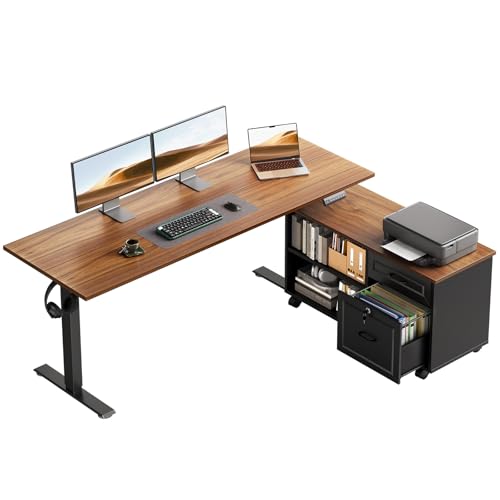
L Shaped Office Desk with Filing Cabinet: The Complete Buyer’s Guide
An L shaped office desk with filing cabinet combines expansive corner workspace with dedicated document storage—the ideal foundation for a productive, clutter-free home office. This guide explains storage options, layout planning, ergonomics, and how to choose the right model for your workflow.
Explore Recommended Models1. Why Choose an L Shaped Desk with Filing Cabinet
Combining an L shaped work surface with an integrated filing cabinet solves two of the most common home office problems at once: not enough workspace and nowhere to file paperwork. Instead of buying a desk and a separate cabinet—then hunting for floor space for both—an all-in-one configuration consolidates your footprint into a single, purposeful zone.
The L shape wraps around a corner, giving you a primary work area plus a secondary return for a printer, reference materials, or a second monitor. The filing cabinet adds lockable, organized storage for invoices, contracts, tax documents, and manuals. For freelancers, remote workers, and small business owners, this combination turns an ordinary room into a genuine home office.
Who benefits most: Remote professionals who handle paper documents regularly, small business owners managing client files, and anyone who wants a dedicated home office without dedicating an entire room to it. If you prefer maximum surface area with separate storage, a traditional L shaped desk with file cabinet layout remains the classic approach.
2. Filing Cabinet Types and Storage Configurations
Not every filing cabinet is the same, and the type you choose affects how well the desk supports your workflow. Here are the main configurations you’ll encounter:
Integrated vs. Detachable Cabinets
- Integrated cabinet: Built into the desk structure, often forming the supporting leg of the return. Sturdy and space-efficient, but not movable once assembled.
- Detachable cabinet: A standalone pedestal that slides under the desk return or sits beside it. More flexible—you can reposition it or use it separately if your needs change.
Drawer Count and Function
- Two-drawer file cabinet: Typically one letter/legal file drawer plus one utility drawer. Compact and ideal for lighter paperwork volume.
- Three-drawer cabinet: Often two file drawers and one shallow accessory drawer. A balanced choice for most home offices.
- Combination pedestal: Mixes file drawers, box drawers, and sometimes a pencil tray. Maximum organization in a single unit.
Locking and Security
If you store sensitive documents, a locking file cabinet is essential. Central-lock systems secure all drawers with one key, while individual locks offer drawer-specific control. Models designed with a locking file cabinet are worth prioritizing for client records or confidential HR paperwork.
For setups that need more than one file drawer, a model with filing drawers in a taller pedestal may suit your document volume better than a single-drawer design.
3. Layout, Orientation, and Room Fit
The beauty of an L shaped desk is that it adapts to your room. But which side should the return go on, and where should the filing cabinet sit? Here are the key decisions:
Reversible vs. Fixed Orientation
A reversible desk with storage lets you assemble the return on the left or right—invaluable when your room layout is dictated by windows, doors, or radiators. Fixed-orientation desks are simpler and often sturdier, but you must measure carefully before ordering.
Where Should the Filing Cabinet Go?
- Under the return: The most common placement. Keeps files within arm’s reach while seated and preserves the main work surface.
- As the return support: Integrated models use the cabinet as a structural leg. Maximum stability and zero wasted floor space.
- Beside the desk: A detachable pedestal can sit at the open end of the L, creating a natural document staging area.
Room Dimensions to Consider
Measure your corner space, wall lengths, and doorway clearances before committing. An L shaped desk typically needs at least 60 inches along each wall to feel comfortable. For tighter rooms, consider models explicitly designed for compact footprints, such as an L shaped desk with drawers for small space.
If your office doubles as a guest room or studio, a desk with integrated storage keeps visual clutter low and maximizes the usable floor area.
4. Ergonomics and Daily Comfort
An L shaped desk gives you room to spread out, but ergonomic success depends on how you arrange the surface. Follow these principles:
Monitor and Keyboard Placement
- Place the primary monitor at the corner or along the longer side, directly in front of your seated position.
- Keep the keyboard and mouse on the same plane—avoid reaching around the corner for daily-use items.
- Use the secondary arm of the L for reference materials, a printer, or a second screen rather than for your main input devices.
The Filing Cabinet as an Ergonomics Tool
Position the file cabinet on the side of your non-dominant hand so you can open drawers without twisting across your body. If you frequently access files while on calls, a cabinet directly under the return keeps movement efficient. A model with a keyboard tray and drawers can further improve wrist posture by lowering the typing surface.
Cable and Power Management
An L shaped desk with a filing cabinet often houses a printer, router, and charging station—all of which generate cables. Look for models with grommets or under-desk cable channels. If your equipment load is heavy, a desk with a built-in power outlet simplifies cord routing considerably.
5. Materials, Build Quality, and Tier Comparison
Build quality determines how long your desk stays stable, how well drawers glide, and whether the surface resists daily wear. Rather than focusing on numbers, use these tier descriptors to compare models within their class:
| Tier | Typical Build | Best For | Durability Notes |
|---|---|---|---|
| Entry-level | Particle board or MDF top, light steel frame, basic drawer slides | Students, light home use, temporary setups | Adequate for occasional use; may show wear sooner under daily heavy loads |
| Mid-range | Laminate or engineered wood top, reinforced steel frame, ball-bearing slides | Daily remote work, home offices with regular paperwork | Solid build for everyday professional use; smoother drawer action |
| Premium | Wood veneer or high-grade laminate, heavy-duty steel frame, soft-close drawers | Full-time professionals, client-facing home offices | Long-term investment; refined finish and quieter operation |
| Commercial-grade | Solid wood or thick laminate, welded steel, full-extension locking drawers | Small business offices, shared workspaces, frequent use | Heavy-duty construction designed for continuous daily operation |
Surface material matters too. Laminate resists scratches and spills well, making it a practical choice for busy desks. Wood veneer offers a warmer aesthetic and a premium feel. For a deeper comparison of surface options, our guide to L shaped wood desks with drawers explains how real wood performs over time.
Check the drawer mechanism carefully—ball-bearing slides are smoother and more durable than basic friction slides, and they matter enormously when you open a loaded file drawer dozens of times a day.
6. Buying Checklist and Common Mistakes
Before you finalize your choice, run through this practical checklist:
Buying Checklist
- Measure twice: Confirm wall lengths, corner clearance, and doorway width for delivery.
- Confirm orientation: Decide left or right return, or choose a reversible model.
- Count your files: Estimate how many file drawers you actually need before choosing drawer count.
- Check the lock: If documents are confidential, prioritize a locking cabinet.
- Verify weight capacity: Consider monitors, printer, and reference books when evaluating frame strength.
- Review assembly requirements: Some integrated cabinets require two-person assembly.
Common Mistakes to Avoid
- Underestimating the return depth: A narrow return may not accommodate a printer or second monitor comfortably.
- Ignoring drawer extension: Partial-extension drawers limit access to the back of the file—look for full-extension slides.
- Placing the cabinet on the wrong side: This forces awkward reaching. Choose reversible designs if you’re unsure.
- Overlooking cable routing: Plan where the printer and router will sit and how cords will reach the wall.
Related reading: If you need additional surface-level storage, compare an L shaped desk with file cabinet and hutch. For executive-style offices, an executive desk with drawers may better match the room’s formality. And if you’re outfitting a complete workspace, browse our collection of L shaped desks for home office use.
7. Frequently Asked Questions
What should I look for in an L shaped office desk with filing cabinet?
Prioritize solid build quality, a cabinet that integrates smoothly with the desk, adequate legroom, and a surface that fits your monitor and work materials. Consider whether the cabinet locks, how many drawers it has, and whether the desk orientation suits your room layout.
Is an L shaped desk with filing cabinet good for small home offices?
Yes, when chosen carefully. An L shaped desk with filing cabinet maximizes corner space and consolidates storage into one footprint. Reversible models let you place the return on either side, which helps in tight rooms.
Can the filing cabinet be detached from the desk?
Many models feature a separate filing cabinet that slides under the desk or sits beside it as a return. Some integrated designs are fixed. Check the product description for detachable or standalone cabinet options.
What tier of L shaped desk with filing cabinet suits a professional home office?
A mid-range to premium tier model with heavy-duty steel frame, scratch-resistant laminate or wood veneer top, and a locking file cabinet is a solid choice for daily professional use. Entry-level models suit lighter use.
Ready to Choose Your L Shaped Office Desk with Filing Cabinet?
Compare recommended models below, then verify dimensions and drawer configuration against your room and document volume. A well-chosen desk becomes the backbone of a productive home office for years.
View Recommended Models