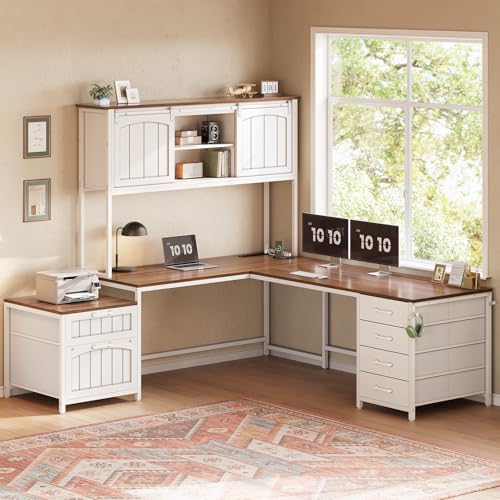
L Shaped Reversible Desk with Storage: The Complete Buyer's Guide
A reversible L shaped desk with storage solves two of the most common home office problems at once: it fits a corner efficiently, and it keeps your workspace organized. Unlike a fixed L desk, a reversible model lets you mount the return and storage pedestal on either the left or right side, adapting to your room, your dominant hand, and your workflow. This guide explains how reversible configurations work, what storage features matter, and how to choose the right model for your space.
What Is a Reversible L Shaped Desk?
A reversible L shaped desk is assembled so that the shorter return section can be attached to either the left or right end of the main desktop. The storage component — whether it is a drawer pedestal, open shelving, or a hutch — typically mounts beneath or above that return. This design flexibility means one product can serve two different room layouts, which is especially valuable when you are unsure about your final furniture arrangement or when you plan to move the desk between rooms.
The reversible mechanism itself is usually straightforward: pre-drilled holes on both ends of the main desktop accept the return brackets, and the storage pedestal attaches with a symmetrical bolt pattern. Some models use a shared side panel that can be flipped, while others simply ship with mirrored hardware. Assembly instructions for reversible desks are generally no more complex than fixed models, but you should confirm the reversal before fully tightening all fasteners.
If you are still exploring whether an L shaped desk is right for you at all, start with our overview of L shaped desks for home office, which covers footprint, ergonomics, and workflow fundamentals.
Why Choose an L Shaped Reversible Desk with Storage?
The combination of a corner-friendly footprint, flexible orientation, and built-in storage delivers practical benefits that a standard rectangular desk cannot match.
- Layout flexibility: Position the return on the left or right to suit window placement, door swing, and cable routing. This is the defining advantage over fixed-orientation corner desks.
- Corner efficiency: The L shape uses the dead corner of a room, freeing wall space for shelving, seating, or decor.
- Integrated storage: Drawers, shelves, and hutches keep documents, peripherals, and office supplies within arm's reach, reducing clutter on the desktop surface.
- Work zone separation: The return creates a natural secondary surface for a printer, reference materials, or a laptop, separating active work from supporting tasks.
- Future-proofing: If you rearrange your room or move, a reversible desk adapts instead of becoming obsolete.
For a broader comparison of storage-rich L desks, see the L shaped desk with storage guide, which covers open shelving, drawer pedestals, and combination units.
Storage Configurations to Consider
Storage is the second half of this desk's value proposition. Reversible L desks with storage generally fall into a few configuration patterns, and each suits a different type of user.
Drawer Pedestal Storage
A pedestal with two to four drawers sits beneath the return. Mid-range models often include one file drawer sized for letter or legal folders plus two utility drawers. This is the most common configuration for home office use because it keeps paperwork and small supplies out of sight.
Open Shelf Storage
Open shelves under or above the return provide quick-access storage for books, binders, and decorative items. Open shelving is lighter visually and suits smaller rooms, though it demands more disciplined organization to avoid visual clutter.
Hutch and Shelf Combinations
A hutch adds vertical storage above the desktop, typically with cubbies, small drawers, and a shelf for a printer or monitor riser. Hutch models are ideal when floor space is limited but vertical space is available. Explore L shaped desk with hutch and storage for detailed comparisons.
File Cabinet Integration
Some reversible desks integrate a full file cabinet with locking drawers into the return. These models suit users who handle sensitive documents or need heavy-duty filing capacity. See L shaped desk with file cabinet for options.
How the Reversible Mechanism Works
Understanding the reversal mechanism helps you evaluate build quality and assembly difficulty. There are three common approaches:
- Symmetrical pre-drilled panels: The main desktop and side panels have mounting holes on both ends. You choose the side during assembly by aligning the return brackets with the corresponding holes. This is the most common and most reliable design.
- Flippable side panel: A single side panel is designed to be rotated 180 degrees, carrying the storage pedestal with it. Fewer parts are involved, but the panel must be sturdy enough to support the pedestal in both orientations.
- Modular bracket system: The return attaches via separate brackets that can be bolted to either end. This approach is common on metal-frame and adjustable-height models, where the frame is symmetric by design.
Whichever mechanism a model uses, verify that the manufacturer specifies a left or right assembly option and that the storage pedestal is designed to sit under either orientation. A truly reversible desk should not require drilling new holes or purchasing extra hardware.
Materials and Build Quality
Material choice affects durability, weight capacity, and the desk's visual character. Reversible L desks with storage span the full range from entry-level to premium tiers.
| Tier | Typical Materials | Best For |
|---|---|---|
| Entry-level | Particle board with laminate finish, light-gauge steel legs | Students, temporary setups, light-duty use |
| Mid-range | MDF or engineered wood with veneer, reinforced steel frame | Daily home office work, mixed storage needs |
| Premium | Solid wood or bamboo tops, heavy-duty steel frame | Long-term investment, heavy equipment, design-focused rooms |
| Commercial-grade | High-pressure laminate, welded steel, locking storage | Professional offices, shared workspaces, document security |
For a deeper look at surface options, our laminate desks guide explains how laminate compares with veneer and solid wood in terms of scratch resistance and maintenance. If you prefer a natural aesthetic, L shaped wood desk with drawers covers solid wood models with integrated storage.
Choosing the Right Orientation for Your Room
The reversible feature is only useful if you plan the orientation before assembly. Consider these factors:
- Dominant hand and monitor placement: If you are right-handed, placing the return on the left keeps your writing and mouse area clear. Left-handed users often prefer the reverse.
- Door and window positions: Avoid placing the return where it blocks a door swing or casts a shadow across your monitor from a window.
- Cable routing: Check where wall outlets are located. The return side should be near power for the storage pedestal's equipment and for any desk-mounted devices.
- Seating clearance: Ensure at least 60 cm of clearance behind the chair on both legs of the L, measured from the desktop edge.
- Future rearrangement: If you might move the desk later, note that reversal requires partial disassembly. Plan for this if you rent or rearrange frequently.
For room-specific layout advice, see L shaped desk with one side shorter, which discusses asymmetrical footprints, and L shaped desk with short right side for compact configurations.
Storage Features That Matter
Not all storage is equal. When evaluating a reversible L desk, check these specific features:
Drawer Glides
Ball-bearing glides with full extension are the practical baseline for daily use. Entry-level models may use friction glides, which are adequate for light loads but wear faster under frequent opening.
File Drawer Capacity
Confirm whether the file drawer accepts letter-size, legal-size, or both. Mid-range and premium models usually include adjustable rails for both formats.
Locking Options
If you store sensitive documents, look for a pedestal with a central locking system. See L shaped desk with locking drawers for models that prioritize security.
CPU and Peripheral Storage
Some pedestals include a dedicated CPU compartment or a shelf for a printer. These are useful in home offices where floor space is limited.
Hutch Depth and Clearance
A hutch should leave enough clearance for your monitor and should not force you to lean forward. Check that the hutch depth is at least 25 cm and that the shelf height accommodates your display.
Cable Management Cutouts
Grommets and rear cutouts keep cables organized when storage sits against a wall. This matters more on reversible desks because the return position changes cable routing.
Ergonomics and Workspace Layout
An L shaped desk offers a natural primary and secondary work zone, but ergonomics depend on placement. Position your monitor at the vertex of the L or along the main desktop, with the return serving as a side surface for reference materials, a printer, or a secondary laptop. Keep the keyboard and mouse on the main desktop at elbow height, and use the return for items you reach less frequently.
If you alternate between sitting and standing, a reversible desk with a standing option combines flexibility with health benefits. Explore L shaped desk with standing option and L shaped sit stand desk with drawers for models that integrate height adjustment with storage.
Monitor arms and a keyboard tray can further refine the setup. The L shaped desk with keyboard tray guide explains how trays interact with corner geometry, while L shaped desk with monitor stand covers raised display options.
Assembly Tips for Reversible Desks
Reversible desks are not difficult to assemble, but the reversal step requires attention. Follow these practical tips:
- Dry-fit before tightening: Attach the return and storage pedestal loosely, confirm the orientation, then tighten all fasteners.
- Check the hardware bag: Reversible models sometimes include mirrored brackets or extra hole plugs. Confirm you have the correct set for your chosen side.
- Use two people for the desktop: Engineered wood desktops are heavy and can crack if twisted during assembly. Lift from the center, not the corners.
- Level the desk after assembly: Adjustable feet compensate for uneven floors, which is important on larger L footprints.
- Anchor if recommended: Tall hutches and heavy pedestals may require wall anchoring for safety, especially in homes with children or pets.
Who Should Buy a Reversible L Shaped Desk with Storage?
This desk category suits a specific set of users. It is a strong choice if you:
- Work from home and need to separate active work from filing and reference materials.
- Have an awkward corner or a room where furniture placement may change.
- Need filing capacity but do not want a separate file cabinet.
- Prefer a single integrated unit over multiple pieces of furniture.
- Are furnishing a first home office and want flexibility for future moves.
It may be less suitable if you need a very compact footprint, since the L shape occupies two wall lengths. In that case, compare L shaped desk with drawers for small space and L shaped desk with one side shorter before committing.
Common Mistakes to Avoid
Ignoring the return depth
A deep return can crowd the room and block chair movement. Measure the return against your available wall length before ordering.
Assuming all models are fully reversible
Some "reversible" desks only allow the return to flip, not the storage pedestal. Confirm exactly which components can be reversed.
Overlooking cable management
Reversing the desk changes where cables exit. Check for grommets and rear cutouts before assembly.
Underestimating drawer quality
Friction glides on an entry-level desk are acceptable for occasional use but wear quickly in daily filing. Ball-bearing glides are the practical baseline for regular use.
Frequently Asked Questions
What does reversible mean on an L shaped desk?
A reversible L shaped desk allows you to assemble the return or storage section on either the left or right side. This flexibility lets you adapt the desk to your room layout, door placement, and dominant hand preference without buying a different model.
How much storage does a reversible L shaped desk typically offer?
Storage configurations vary widely. Entry-level models often include open shelves and a small drawer, while mid-range and premium models may feature file drawers, CPU storage, hutch shelves, and locking cabinets. The reversible design usually applies to the storage pedestal, meaning you can position drawers under either the main desktop or the return.
Is a reversible L shaped desk suitable for small rooms?
Yes, when chosen carefully. A reversible design helps you maximize corner space, but you should measure both wall lengths and account for the return depth. Compact reversible models with a shorter return side work well in small home offices, while full-size models suit larger dedicated workspaces.
What materials are best for an L shaped reversible desk with storage?
Engineered wood with a laminate or veneer finish offers a balanced combination of durability and design flexibility for mid-range models. Solid wood and bamboo represent the premium tier, providing superior longevity and a natural aesthetic. High-grade steel frames are common on adjustable or heavy-duty reversible desks.
Ready to Set Up Your Reversible L Desk?
A reversible L shaped desk with storage combines layout flexibility with practical organization. Before you order, confirm the reversal mechanism, storage configuration, and material tier that match your workflow. Browse our recommended models below to compare features and find the configuration that fits your home office.
Explore Recommended Models