Desk and Chair: The Complete Pairing Guide for a Healthier Workspace
Everything you need to know about matching a desk with the right chair — ergonomic fundamentals, tier comparisons, adjustment checklists, and practical pairing strategies for home offices, small spaces, and shared workstations.
Explore Desk & Chair Options
The desk and chair relationship matters more than either component alone. A premium chair under a poorly sized desk will still cause shoulder and wrist strain. A well-designed desk paired with an unsupportive chair will leave your back aching by mid-afternoon. This guide explains how the two pieces interact, what to check before you commit, and how to choose a pairing that supports posture, focus, and long-term comfort.
Why the Desk and Chair Must Be Chosen Together
Most buyers research desks and chairs separately, then assemble the two at home and hope for the best. That approach usually produces a workstation where one component fights the other. The chair sets your seated hip height, thigh angle, and lumbar contact point. The desk then dictates where your forearms rest, how far your monitor sits, and whether your shoulders stay relaxed. When those two sets of measurements conflict, your body absorbs the difference — usually in the neck, shoulders, and lower back.
The core principle is simple: the chair determines your seated posture, and the desk must conform to that posture. This is why adjustable-height desks pair so well with almost any ergonomic chair — the surface can be tuned to the individual rather than forcing the individual to adapt to a fixed surface. If you are still comparing surface materials and constructions, our guide to desk accessories covers complementary add-ons that improve the pairing, while the broader desk ergonomics overview explains the biomechanics behind these recommendations.
For readers specifically shopping for a matched set, the desk and chair set overview compares coordinated packages, and the home office desk and chair guide narrows the options for remote-work setups. If space is tight, the small-space desk and chair set page covers compact pairings that still preserve ergonomic integrity.
Desk and Chair Tiers Compared
Instead of comparing individual models by price point, it is more useful to understand the quality tier each component belongs to and how those tiers interact. The table below maps desk and chair tiers against the workspace scenarios they suit best.
| Tier |
Typical Desk Characteristics |
Typical Chair Characteristics |
Best For |
| Entry-level |
Fixed height, laminated or engineered top, basic frame |
Fixed or simple height adjustment, minimal lumbar shaping |
Short daily sessions, student rooms, occasional use |
| Mid-range |
Height-adjustable or sturdy fixed top, reinforced frame |
Adjustable arms, lumbar support, breathable upholstery |
Daily home office work, multi-hour sessions |
| Premium |
Electric sit-stand, solid wood or high-grade laminate top |
Multi-point adjustment, synchronized tilt, headrest option |
Full-day professional use, posture-conscious users |
| Commercial-grade |
Heavy-duty frame, high load capacity, cable management built in |
Durable mechanism, extended warranty, high back with neck support |
Shared offices, hot-desking, intensive daily use |
A common mistake is mixing tiers unevenly — for example, a premium ergonomic chair under an entry-level fixed-height desk. The chair's support is wasted if the desk forces your arms into an awkward angle. Conversely, a mid-range adjustable desk paired with a mid-range chair with lumbar support often delivers a more balanced result than one premium component and one entry-level component. The guiding rule: match tiers where the two components physically interact — at the seated forearm, elbow, and thigh contact points.
Four Pairing Strategies That Work
The Adjustable-First Approach
Choose an electric or manual sit-stand desk and a chair with solid lumbar support. The adjustable surface absorbs height mismatches, so the chair only needs to handle posture and comfort. This is the most forgiving pairing for people of different heights sharing a workspace.
The Chair-First Approach
Select the chair based on your body and sitting habits, then measure your seated elbow height and match the desk to it. Best for users with specific back or neck concerns who need the chair to be non-negotiable.
The Compact Pairing
For small rooms, pair a compact desk with a chair that tucks fully underneath — ideally one without arms or with fold-away arms. Confirm the chair's minimum seat height clears the desk apron and any drawer housing.
The Coordinated Set
Buying a matched desk and chair set removes the measurement guesswork, since the manufacturer has already aligned surface height and seat height. Verify the adjustment range still covers your body dimensions before committing.
Pre-Purchase Pairing Checklist
- Seat height range: Confirm the chair's lowest seat height allows your feet to rest flat while your thighs stay roughly parallel to the floor.
- Desk surface height: With your elbows at your sides and forearms extended, the surface should meet your forearms without lifting or dropping your shoulders.
- Knee clearance: Check that the desk apron, drawers, or crossbar leave at least a few inches above your thighs when seated.
- Armrest clearance: If the chair has arms, verify they slide under the desk edge or stop below it so you can pull close to the keyboard.
- Monitor distance: The desk depth should place the screen roughly an arm's length away once your chair is positioned correctly.
- Chair mat compatibility: On carpet or hardwood, plan for a desk chair carpet mat or a desk chair mat for hardwood floors so the chair rolls smoothly without damaging the floor.
- Lumbar contact: The chair's lumbar curve should meet your lower back without a gap when you sit fully back in the seat.
Choosing the Chair Side of the Pairing
The chair deserves more scrutiny than most buyers give it, because it is the component your body contacts for the entire session. Start with support: a chair with lumbar support maintains the natural inward curve of the lower back, while models with back support extend that structure up through the thoracic region. If you already experience discomfort, the guides to a desk chair for back pain and a desk chair for lower back pain break down which features actually help.
Adjustability is the second pillar. A chair with adjustable arms lets you bring the armrests to elbow height, which reduces shoulder tension during typing. An adjustable-height chair without wheels suits stationary setups where floor protection or stability matters more than mobility. For users who prefer a firmer, more upright seat, the ergonomic desk chair category covers the mainstream options.
Sitting style also influences the choice. Readers who tuck one leg under themselves should look at a desk chair for sitting cross-legged, which typically offers a wider, flatter seat pan and a lower front edge. Those who want to recline between tasks can compare desk chairs that recline. And if the chair will be visible in a living space, the desk chair that doesn't look like a desk chair selection blends residential styling with ergonomic internals.
Choosing the Desk Side of the Pairing
The desk's job is to hold the surface at the correct height and provide enough depth for your monitor, keyboard, and reference materials. Height adjustability is the single most valuable desk feature for pairing purposes. A electric standing desk lets you shift between seated and standing postures without changing chairs, while a manual standing desk offers the same flexibility with a simpler mechanism.
For small rooms, a compact desk paired with a slim chair keeps the footprint tight without sacrificing the seated geometry. Corner placements benefit from a corner desk setup, which uses the wall junction to gain depth while keeping the chair's roll zone clear. If the workspace doubles as a bedroom, a bedroom desk setup guide covers layouts that keep the chair from blocking circulation paths.
Surface material matters less for pairing than geometry, but it still affects comfort and durability. Wood tops feel warmer and absorb sound, while laminate surfaces resist scratches and are easier to wipe down. Whichever you choose, confirm the desk's underside is free of sharp edges or protruding hardware that could catch the chair's armrests as you roll in and out.
Five Pairing Mistakes to Avoid
- Buying the desk before measuring the chair. Seat height varies significantly between models. Measure your seated elbow height first, then choose a desk that matches it.
- Ignoring armrest-to-desk clearance. Armrests that collide with the desk edge force you to sit farther back, which pushes the keyboard out of comfortable reach.
- Assuming a fixed desk fits everyone. A fixed-height desk suits one body size well and everyone else poorly. Adjustability is the safer pairing foundation.
- Skipping the floor-protection plan. Chair casters wear through carpet and scratch hardwood over time. A desk chair floor protector or a dedicated desk floor mat preserves the floor and improves rolling resistance.
- Overlooking the monitor relationship. The desk depth and chair recline angle together determine screen distance. Pair a deep desk with a chair that lets you sit back, or a shallow desk with a more upright chair.
Recommended Desk and Chair Pairings
⚠️ AFFILIATE DISCLOSURE: This website contains affiliate links. As an Amazon Associate, we earn from qualifying purchases. If you make a purchase through these links, we may receive a small commission at no additional cost to you.
Read our full affiliate policy.
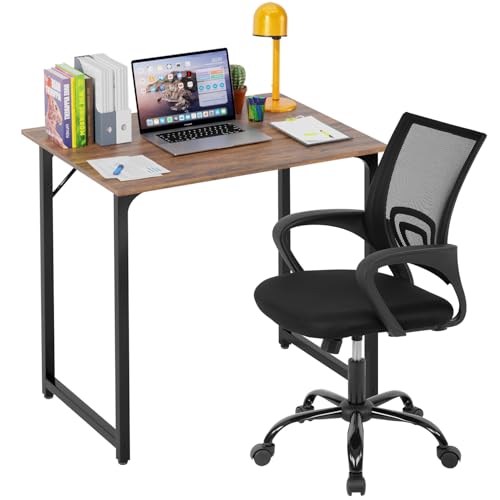
PayLessHere | 32" Office Desk with Ergonomic Office Chair | Vintage & Black | with Height Adjustable and Reclining Chair | Sturdy Computer Desk with Thick Desktop and Adjustable Legs | For Home, Office
Check price on Amazon
⚠️ Note: The purchase links above are affiliate links. As an Amazon Associate, we earn from qualifying purchases at no additional cost to you.

DUMOS 31.5 Inch Small Computer Desk for Home Office Bedroom, Black & White | Modern Study Writing Work Table, Craft PC Gaming Desk Simple Workstation with Reinforcement Structure
Check price on Amazon
⚠️ Note: The purchase links above are affiliate links. As an Amazon Associate, we earn from qualifying purchases at no additional cost to you.

Lufeiya Black Gaming Desk with LED Lights and Power Outlets, 40 Inch Teen Writing Study Table Home Office Desks with Monitor Stand, Computer Desk with Charging Station USB Port, Black
Check price on Amazon
⚠️ Note: The purchase links above are affiliate links. As an Amazon Associate, we earn from qualifying purchases at no additional cost to you.

BestOffice Ergonomic Office Chair | Mid-Back Swivel Desk Chair | Dark Black | with Lumbar Support, Adjustable Height & Breathable Backrest | Sponge Seat & Rolling Wheels | for Home, Office | Pack of 1
Check price on Amazon
⚠️ Note: The purchase links above are affiliate links. As an Amazon Associate, we earn from qualifying purchases at no additional cost to you.

Huuger Computer Desk, 55 Inch Home Office Desk, Gaming Writing Work from Home Study Desk, Large Legroom, Sturdy Metal Frame, Modern Simple, Rustic Brown
Check price on Amazon
⚠️ Note: The purchase links above are affiliate links. As an Amazon Associate, we earn from qualifying purchases at no additional cost to you.

FEZIBO Standing Desk 48 × 24 Inch Electric Height Adjustable, Maple | Sit and Stand Up Adjustable Desk, Home Office Computer Desk with 3 Customizable Memory Presets
Check price on Amazon
⚠️ Note: The purchase links above are affiliate links. As an Amazon Associate, we earn from qualifying purchases at no additional cost to you.

Furinno Simplistic 31-Inch Compact Computer Desk, Black Espresso | Small, Rectangular, Easy Assembly, Office Desk, Home Office Desk, Gaming Desk for Dorm, Bedroom, Study Room
Check price on Amazon
⚠️ Note: The purchase links above are affiliate links. As an Amazon Associate, we earn from qualifying purchases at no additional cost to you.

DAOUTIME White Computer Desk with Drawers, 37.3 Inch Home Office Work Desk with Storage Shelf, Kids Teens Study Table for Small Space, Small Writing PC Table for Bedroom Makeup Vanity Desk
Check price on Amazon
⚠️ Note: The purchase links above are affiliate links. As an Amazon Associate, we earn from qualifying purchases at no additional cost to you.
Frequently Asked Questions
How do I know if my desk and chair are paired correctly?
A correct pairing keeps your forearms parallel to the floor, your feet flat on the ground, and your monitor at eye level. If you need to hunch, stretch, or slide forward to reach your keyboard, the pairing needs adjustment — usually a change in seat height first, then desk height.
Should I choose the chair or the desk first?
Choose the chair first. The chair determines your seated height and posture, and the desk height must then be matched to that seated position. An adjustable-height desk makes this matching far easier because it can conform to any chair rather than forcing a compromise.
What is the ideal desk height for a standard office chair?
Most standard office chairs place the seated elbow height between roughly 24 and 27 inches above the floor, so a desk surface around that range works for most adults. Adjustable-height desks remove the guesswork entirely and are the safer choice when multiple people share the workstation.
Can a premium chair fix a poorly sized desk?
Only partially. A premium ergonomic chair can correct posture and support, but if the desk is too high or too low, the chair cannot compensate without creating arm, shoulder, or neck strain. The two components must work together, which is why the tier-matching approach in this guide is more reliable than optimizing one piece in isolation.
