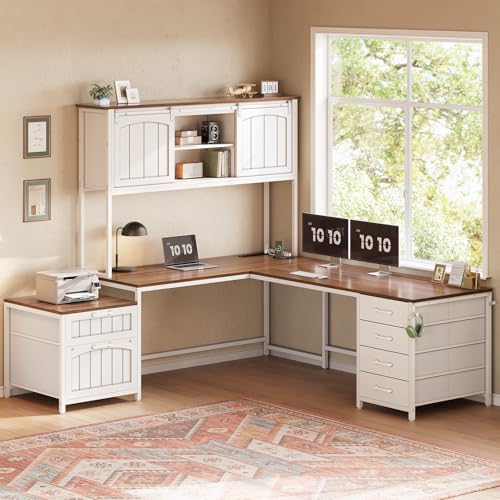
L Shaped Desk With Hutch on Right Side: The Complete Workspace Guide
Everything you need to know about choosing, arranging, and living with an L shaped desk that has a hutch on the right side — layout logic, storage planning, ergonomics, material choices, and real-world setup advice.
Explore Recommended OptionsWhy the Right-Side Hutch Matters
An L shaped desk with a hutch on the right side is one of the most practical corner workstation configurations available. The hutch — the vertical shelving unit that sits on top of the desk surface — transforms a flat work area into a layered storage system. By placing that hutch on the right return, you keep the main working stretch of the desk clear while still gaining vertical storage within arm's reach.
The right-side orientation is not arbitrary. For most people, the dominant hand is the right hand, which means the right side of the desk naturally becomes the "active" side — the place where you reach for a notebook, a reference binder, a pen cup, or a charging cable. Putting the hutch there keeps those frequently used items organized without forcing you to twist toward the left side of the desk.
The configuration also solves a common corner-desk problem: when a hutch sits directly in front of your monitor, it can crowd your sightline and make the workspace feel enclosed. Moving the hutch to the right return keeps the primary viewing area open and airy while still providing the storage depth that makes an L-shaped layout worthwhile.
Quick definition: The "return" is the shorter leg of the L. In a right-side hutch configuration, the hutch rests on that return, while the longer leg of the desk stays open for monitors, keyboards, and daily work.
Understanding the L Shape and Return
To choose the right desk, it helps to understand how an L-shaped desk is built. The unit consists of two connected work surfaces: a main leg and a return. The return can sit on the left or the right, and the desk can be "reversible" (meaning the return can be installed on either side) or fixed. When the hutch is mounted on the right return, the desk is typically described as a right-hand hutch model.
The return length determines how usable the hutch really is. A short return of around 35 to 42 inches still fits a compact hutch with two or three shelves, but a longer return of 47 inches or more allows a full hutch with closed cabinets, open cubbies, and a top display shelf. If your room is tight, a model with a short right side keeps the footprint manageable while retaining the hutch benefit.
Reversibility is a feature worth checking. A reversible desk can be assembled with the return on either side, which is useful if you move rooms or want to reposition the desk later. Fixed right-hutch models are typically more rigid and often better reinforced, but they lock you into one orientation.
| Return Length | Hutch Capacity | Best For |
|---|---|---|
| Short (under 42 in) | Two shelves, open cubbies | Compact rooms, apartments |
| Medium (42–47 in) | Three shelves, mixed open and closed | Home offices, students |
| Long (48 in+) | Full hutch with cabinets and display top | Executive and professional setups |
Storage and Organization Strategy
The hutch is the reason many people choose an L-shaped desk in the first place, so it deserves a deliberate storage plan. A right-side hutch works best when it is treated as a vertical filing and reference zone, not as a dumping ground. Think in layers: the top shelf for display and rarely used items, the middle shelves for books and binders, and the lowest cubbies for items you touch every day.
If you need more than shelving, look for a model with hutch and drawers, which pairs the vertical storage with closed drawer storage below the surface. Models with a file cabinet and hutch give you a dedicated place for letter and legal folders, which is ideal for anyone who still works with paper records. For heavier document loads, a locking file cabinet adds a layer of security.
Open shelving is flexible but collects dust, so consider closed-door hutches if the desk sits in a shared or high-traffic room. A hutch with a mix of open cubbies and closed compartments offers the best of both worlds: display space on top and concealed storage below.
- Top shelf: decorative items, reference books, framed photos.
- Middle shelves: binders, manuals, project folders.
- Lower cubbies: daily-use notebooks, pens, charging accessories.
- Closed compartments: paperwork, cables, office supplies you do not want on display.
Ergonomics and Monitor Placement
A hutch changes the ergonomics of a desk more than most buyers expect. Because the hutch rises above the work surface, it can limit how high you can raise a monitor or how far back you can push a monitor arm. The general rule is to place your primary monitor on the main leg of the desk — not under the hutch — so your sightline stays clear and the top of the screen sits at or slightly below eye level.
If you use a dual-monitor arrangement, the main leg of the L comfortably fits a primary and secondary display side by side. The hutch on the right return then becomes a storage and reference wall behind the secondary monitor rather than an obstruction. For users who prefer a single large display, a monitor stand raises the screen above the desk surface without relying on the hutch.
Keep the keyboard and mouse on the main leg, centered on the primary monitor. Avoid placing the keyboard under the hutch, because the overhead shelving creates a visual ceiling that can make long work sessions feel cramped. If you need a keyboard closer to the hutch, a keyboard tray keeps the surface clear and positions the keyboard at a more comfortable height.
Chair clearance matters too. The open leg of the L should give you enough room to roll the chair back and stand up without bumping the return. A hutch on the right side does not affect chair clearance, which is one of its practical advantages over a centered hutch.
Ergonomic tip: Set the desk height first, then adjust the chair, then place the monitor. The hutch should never dictate your posture — it should support it.
Materials and Build Quality
Hutches add weight and leverage to a desk, so build quality matters more than it does on a flat writing table. The frame should be made from high-grade steel or solid hardwood, not thin tubular metal. Look for reinforced corner brackets where the two legs of the L meet, because that joint carries the most stress over time.
For the desktop and hutch shelves, engineered wood with a durable laminate or veneer finish is common and performs well in home offices. Solid wood options such as wood desk with hutch offer a warmer look and can be refinished later, though they are heavier and require more careful assembly. If you prefer a cleaner, more modern aesthetic, a white or light-toned finish keeps the hutch from feeling visually heavy in a small room.
Check the weight rating of the hutch shelves. A hutch loaded with binders and books can weigh significantly more than the manufacturer's baseline, so look for a stated per-shelf capacity. Shelves that are 0.75 inch thick or more resist sagging better than thin panels. If the hutch includes doors, confirm that the hinges are metal rather than plastic, because plastic hinges fatigue quickly under daily use.
| Build Tier | Frame | Surface | Best For |
|---|---|---|---|
| Entry-level | Powder-coated steel tube | Laminate over particle board | Light home office use |
| Mid-range | Reinforced steel frame | Laminate or veneer over MDF | Daily work, students |
| Premium | Heavy-duty steel with cross-bracing | Solid wood or high-grade veneer | Professional and executive setups |
| Commercial-grade | Welded steel frame | Scratch-resistant high-pressure laminate | Shared offices and heavy daily use |
Matching the Desk to Your Room
The right-side hutch configuration is especially useful in rooms where the desk must tuck into a corner. Because the hutch sits on the return, it occupies the corner space that would otherwise be wasted, leaving the main leg open toward the center of the room. This is why L-shaped desks are so common in L-shaped desks for home office setups — they make efficient use of awkward corners.
Before buying, measure the corner and the walls on both sides. The return should sit flush against one wall, and the main leg should extend along the other. Leave at least 30 inches of clearance behind the chair for movement. If the room is narrow, a model with one side shorter than the other keeps the walkway open. If the room is large, a full executive-style unit with a hutch and drawers can anchor the space.
Consider the window position. Placing the main leg perpendicular to a window reduces glare on the monitor, while the hutch on the right return can sit against a solid wall for stability. Avoid putting the hutch directly in front of a window, because the shelving will block light and create shadows across the desk surface.
Cable Management With a Hutch
A hutch is a cable management opportunity, not just a storage feature. The vertical space between the shelves and the wall is ideal for routing power strips, router cables, and charging cords out of sight. Many hutches include a cable cutout or a small grommet on the back panel; if yours does not, a simple adhesive cable clip can route cords along the underside of a shelf.
Mount a power strip to the back of the hutch rather than leaving it on the floor. This keeps the strip accessible and lifts it away from dust and spills. For monitors and speakers, route cables down the back of the hutch and along the desk frame, using velcro ties rather than zip ties so you can adjust the layout later. If the desk includes a power outlet, use it for the devices you unplug most often, and keep the heavier equipment on a separate surge-protected strip.
Cable trays mounted under the main leg complete the setup. The goal is to keep the floor under the desk clear so the chair rolls freely and cleaning is easy.
Common Setup Mistakes
Most dissatisfaction with an L-shaped desk and hutch comes from setup choices rather than the desk itself. Here are the mistakes that come up most often:
- Putting the monitor under the hutch. This crowds the sightline and forces you to sit too close to the shelves. Keep the primary display on the open leg.
- Overloading the top shelf. Heavy books on the highest shelf raise the center of gravity and stress the hutch mounts. Put heavy items on lower shelves.
- Ignoring the return depth. A hutch on a shallow return leaves little usable surface. Measure the return depth before choosing the hutch style.
- Skipping the wall anchor. Tall hutches should be secured to the wall with the included anti-tip strap, especially in homes with children or pets.
- Blocking the cable cutout. Pushing the desk flush against the wall can pinch cables. Leave a small gap or use a wall-mounted cable channel.
- Choosing a hutch that is too tall. A hutch that rises above eye level makes the workspace feel enclosed. Keep the top shelf within comfortable reach.
Who Should Choose This Layout
The right-side hutch layout suits several specific user profiles. It is a strong choice for remote workers who need reference storage within reach but want the main desk surface clear for a laptop and a second monitor. It works well for students who need shelf space for textbooks and binders while keeping the writing area open. It is also a natural fit for small home offices where the desk must occupy a corner and every vertical inch counts.
If your priority is a minimalist, floating desk aesthetic, a hutch may feel too heavy. In that case, a desk with storage in the form of drawers rather than a hutch keeps the visual profile lower. If you want a more traditional executive look, an executive desk with hutch combines the right-side storage with a formal finish.
For users who alternate between sitting and standing, a fixed hutch is not compatible with a height-adjustable frame. In that case, look at a standing option instead, which prioritizes adjustability over overhead storage.
Frequently Asked Questions
Can an L-shaped desk with a right-side hutch be assembled with the hutch on the left?
Only if the model is explicitly reversible. Fixed right-hutch models have pre-drilled mounting points on one side. Check the product description for "reversible" before assuming you can flip the orientation.
How much weight can a desk hutch hold?
It varies by model, but most hutches are rated for 30 to 50 pounds per shelf when properly anchored. Always follow the manufacturer's stated capacity and distribute heavy items across lower shelves.
Is a hutch suitable for a small room?
Yes, if the hutch is open rather than closed and the top shelf stays below eye level. Open shelving keeps the visual weight down, and a light finish prevents the unit from dominating the room.
Can I use a monitor arm with a hutch on the right side?
Yes. Mount the monitor arm on the main leg of the desk, away from the hutch, so the arm has clearance to move. Avoid clamping the arm to the hutch itself.
What is the difference between a hutch and a bookshelf on an L-shaped desk?
A hutch is mounted directly on the desk surface and moves with the desk. A bookshelf is a separate freestanding unit. Hutches save floor space; bookshelves offer more capacity and can be repositioned independently.
Ready to Plan Your Right-Hutch Workspace?
Browse recommended L-shaped desks with a right-side hutch below and compare features, storage layouts, and build tiers before you decide.
View Recommended Desks