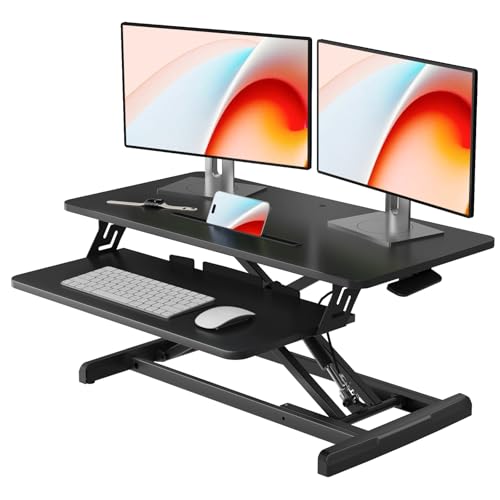
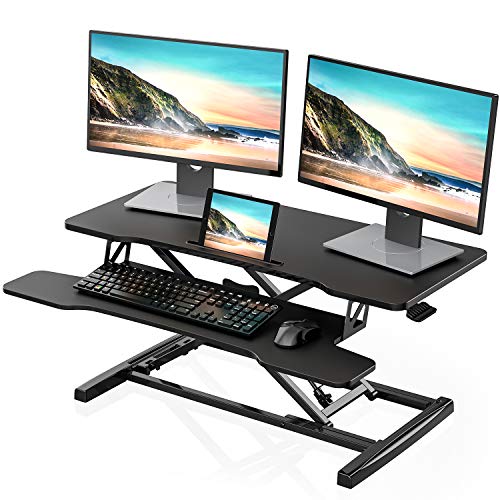
Standing Desk Converter with Adjustable Keyboard Tray
Upgrade your existing desk into an ergonomic sit-stand workstation with a fully adjustable keyboard tray. Improve posture, reduce back pain, and boost productivity — all without replacing your entire desk.
⭐ Why a converter with an adjustable keyboard tray? It gives you the freedom to position your keyboard and mouse at the optimal height for your arms and wrists, while your monitor stays at eye level. This dual‑adjustment (monitor + keyboard) is the gold standard for desktop ergonomics.
⚡ Height Range
Typically 4–20 inches of lift. Choose based on your height and desk thickness.
⌨️ Keyboard Tray
Separate, tilt‑able tray for wrists. Keeps arms at 90° for zero strain.
📱 Monitor Platform
Holds one or two monitors + laptop. Width varies from 26″ to 40″.
💪 Weight Capacity
From 22 lbs up to 44 lbs. Ensure your setup (monitors + laptop) is within limit.
🛠️ Gas Spring / Crank
Most use gas springs for smooth lifting. Crank‑operated models are cheaper but less convenient.
📦 Ease of Setup
Simply place on your existing desk. No tools required for most models.
What to Look For in a Standing Desk Converter with Adjustable Keyboard Tray
A standing desk converter is a riser that sits on top of your current desk. It lets you alternate between sitting and standing in seconds. When it includes a separate, adjustable keyboard tray, it offers superior ergonomics because your keyboard can be lower than your monitor — exactly as recommended by health experts.
Here are the critical factors to evaluate before buying:
- Height adjustment range: The converter should go high enough to accommodate your height (elbows at 90° when standing). Look for a lift of at least 15–20 inches. If you are over 6' tall, choose a model with extra height or one designed for tall people. See our guide on standing desk converters for tall persons.
- Keyboard tray depth & tilt: The tray should be large enough for your keyboard and mouse. Tilt (negative/positive) helps keep wrists straight. Some trays also slide under the main platform when not in use.
- Monitor platform size & capacity: Ensure it can hold your monitor(s) and laptop. If you use a dual‑monitor setup, consider a model with a wider platform or a dedicated converter with dual monitor mount.
- Stability: Look for a wide, sturdy base and non‑slip pads. Stability is crucial when typing or writing.
- Ease of use: Gas‑spring assisted converters are smooth and easy to lift. Crank‑operated models are cheaper but require more effort.
- Desktop space: Measure your current desk to ensure the converter fits. For narrow desks, check models designed for narrow desks.
💡 Pro tip: If you frequently switch between sitting and standing, choose a converter with a quick‑release lever or handle so you can adjust height without breaking your workflow.
Price & Feature Comparison
Below is a general comparison of popular types. Prices are approximate for mid‑range models (as of 2026).
| Type | Height Range | Keyboard Tray | Weight Capacity | Price (USD) |
|---|---|---|---|---|
| Basic gas‑spring | 4″ – 16″ | Fixed (non‑tilt) | 22 lbs | $120–$200 |
| Premium gas‑spring (with tilt tray) | 4″ – 20″ | Tilt‑adjustable & slide | 33 lbs | $200–$350 |
| Wide platform (dual monitor) | 4″ – 18″ | Large tray, tilt | 44 lbs | $260–$400 |
| Crank‑operated (budget) | 4″ – 15″ | Basic tray | 22 lbs | $90–$150 |
* Prices are estimated averages for quality products. Actual prices may vary by brand and features.
Ergonomics & Health: Why the Adjustable Keyboard Tray Matters
When you use a standing desk converter without a separate keyboard tray, you often end up with your keyboard too high, forcing your wrists into extension. This can lead to carpal tunnel syndrome and shoulder tension. A dedicated tray lets you keep your keyboard at elbow height while your monitor is at eye level — the ideal posture for reducing strain.
Key health benefits:
- Reduced back pain: Alternating between sitting and standing reduces pressure on your lumbar spine.
- Better wrist alignment: A tilt‑adjustable tray keeps your wrists neutral, preventing repetitive strain injuries.
- Increased energy: Standing while working boosts circulation and can improve focus.
- Long‑term productivity: Comfortable workers are more productive and less prone to fatigue.
If you already have a standing desk with a keyboard tray, you may not need a converter. But for those with an existing traditional desk, a converter is the most cost‑effective upgrade.
Who Is This For?
- Home office workers who want standing benefits without buying a new desk.
- Employees with limited budgets — converters are cheaper than full electric standing desks.
- Anyone with a non‑adjustable desk (e.g., IKEA, vintage, or built‑in desks).
- People who share a desk — converters are portable and can be moved easily.
- Gamers who want the ergonomic edge for long sessions.
💡 If you have a small workspace, consider a converter designed for small desks to save surface area.
Installation & Usage Tips
- Measure your desk: Ensure the converter base fits within your desk depth (usually 24″–30″).
- Position the monitor: Place your monitor at the highest setting first, then adjust the keyboard tray separately.
- Find your standing height: Elbows should be at 90°, wrists straight. Fine‑tune with the tray tilt.
- Keep a standing mat nearby: An anti‑fatigue mat can make standing more comfortable.
- Alternate regularly: Aim for a 30‑minute sitting / 30‑minute standing cycle.
For more ideas on optimizing your workspace, explore our desk setup & layout guides.
Frequently Asked Questions
- Can I use a converter with a curved monitor? Yes, as long as the platform is wide enough (check the weight and base width).
- Is assembly required? Most converters come fully assembled; you just place them on your desk.
- Can I add a monitor arm later? Some converters have VESA mounts; otherwise, you can use a separate converter with a built‑in monitor mount.
- How much weight can the keyboard tray hold? Usually 5–10 lbs, sufficient for most keyboards and mice.
✅ Ready to upgrade your workspace? Choose a standing desk converter with an adjustable keyboard tray from the recommended products below. All options are vetted for quality, stability, and ergonomic design.